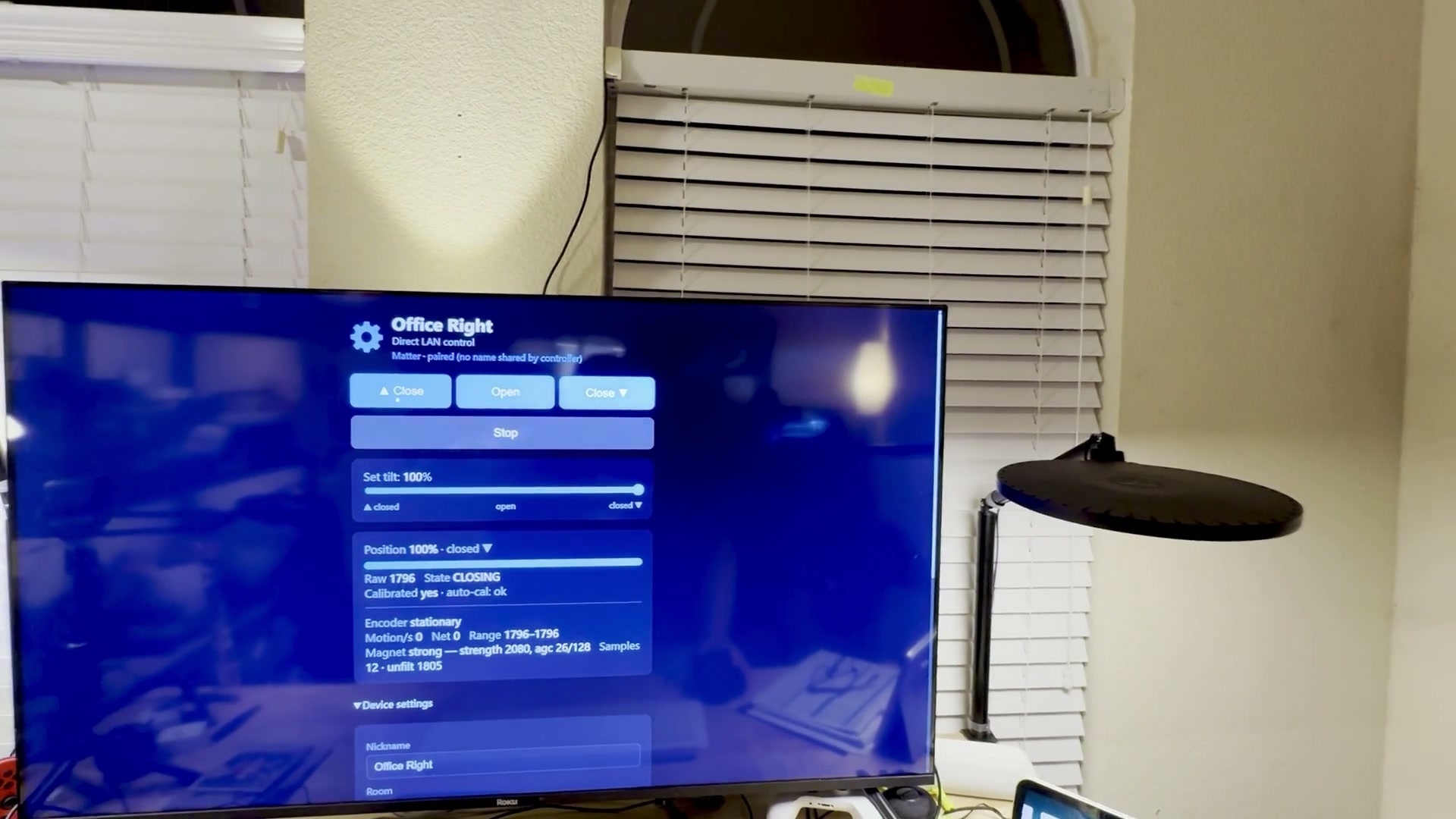
It Moves
A dispatch from the office, September 2026. The build journal (start at The Wife Test) has spent most of a year on gearboxes that didn't work.
Monday night
I opened a browser, typed a device name into it, and the blinds in my office opened. Then I closed them. Then I did it again.
That's the post. There's no launch in it and nothing to announce — it was a Monday night in late September and I was standing in my own office, watching the thing I assumed would take a few weekends. Ten months ago I thought this part would be easy.
The first successful full tilt under web control. Alpha hardware, shipping firmware, phone camera, trimmed and not otherwise edited.
This is an install, not a bench rig
That matters more than the video makes obvious. The unit is inside the headrail of a blind hanging in my office window, turning that blind's own tilt rod. Nothing is clamped to a table, nothing is propped up for the camera, and the only thing running to it is a USB-C cable down the wall.
Nothing in the chain is a stand-in any more either, which is the other reason it's worth a post. The board is Rev D — from the hundred-board lot in One Hundred Boards, encoder on the PCB, motor lead and USB-C the only wires. The drivetrain is the two-axis worm arrangement from Two Axes: N20 gearmotor, friction clutch on the motor spur, pinion into a 28-tooth spur, module-0.8 2-start worm into a 20-tooth wheel on the tilt rod. Ten to one, self-locking at a 3.2° lead angle, which is why the slats hold where they stop with the power off.
And the clutch works. Not on the bench under a finger — against a real tilt rod carrying real slats, which is the load it was designed around and the one I could never honestly fake.
Siri does it too
The web page is the part I care about, but it isn't the only way in. The unit is commissioned in Apple Home over Matter — no hub, no bridge, no account of mine in the middle — and voice works. I can tell Siri to close the office blinds and they close.
That same night I set the automations I've been describing to people for the better part of a year: open on schedule in the morning, close at sunset. Whether they go on working, week after week, without me thinking about them — that's the part worth reporting, and I'll say either way.
The page is coming off the device
Worth saying plainly, because it's easy to miss in a video of some blinds moving: that control page is served by the ESP32-C6 itself. No app, no account, nothing of mine in between. It hands out the page and takes open, close, stop, and a tilt position over the same small JSON API the no-reflash Home Assistant setup talks to.
So Matter is the easy path and it's what most people will use — Apple Home, Google Home, Alexa, SmartThings, Home Assistant. But it's a convenience I picked, not a dependency I'm stuck with. If the Wi-Fi is up, the blind moves. If the internet is down, the blind moves. If Apple changes something, the blind moves. If TiltForge stops existing, the blind moves, because there's nothing to switch off.
Eight dead commercial tilt motors in this house are the reason that mattered enough to build around.
Still on the list
Two attachments, and neither one is electrical.
The cord reel isn't fitted and the cord isn't laced down. That's the piece that makes the pull cord work alongside the motor — the requirement the clutch exists to satisfy, going back to No Spring. And for wand blinds there's the other end of it: an eye screw into the axle, which isn't in yet either.
The drivetrain is built to take both. They just aren't on there yet, which is why the clip that should end this post — a hand pulling the cord while the position updates live on the phone in the same frame — doesn't exist. That one is the actual difference between this and every other smart blind motor, and I'd rather post it late than stage it.
Both go in the next videos. Cord on one, wand on the other.
Next
Fit the reel. Lace the cord. Put the eye screw in. Film both.
This journal has documented ten months of things not working, mostly on purpose, and I'm not going to start rounding up near the end. But as of Monday there's a window in this house where the thing I've been describing for a year is just how the blinds work now.
The TiltRod, by TiltForge, is a retrofit smart blind motor — repairable, open, Matter-native, and the cord always works. Founders pricing on the first 100 units; first units ship November 2026. Check your headrail at tiltforge.com/fit or follow the build at tiltforge.com/#waitlist.
TiltForge — a retrofit smart blind motor. Repairable, open, Matter-native, and the cord always works.
Follow the build — new entries straight to your inbox