The Wife Test
Behind every great man is a woman... rolling her eyes.
Post 1 of the TiltForge build journal — how a public smart-home failure and a $5 Amazon part turned into an eight-month engineering education. Reconstructed from the folder archive, one brutally honest spreadsheet, and what's left of my dignity.
Passing
Our living room has a big window — six feet wide, heavy 2.5" tilt blinds — with a three-foot window on each side. Prime real estate. High visibility. So in October 2019, when I retrofitted smart tilt motors onto our blinds, something rare happened.
My wife loved it.
You have to understand the baseline here. My gadget-and-smart-home obsession is something she tolerates, and the tolerance is documented. Her Facebook feed is a fourteen-year running roast of my experiments. Exhibit A, from all the way back in 2011:
"I love Joe — early adopter of all things nifty. I've been given countless lessons in universal remotes, wireless networks, programmable dog food dispensers, gps, iPhone apps, etc. I can open the garage door from my classroom but I can't turn on the TV sitting in front of it! Just when I get the hang of the latest whiz-bang gadget, it becomes obsolete. He keeps me on my toes."
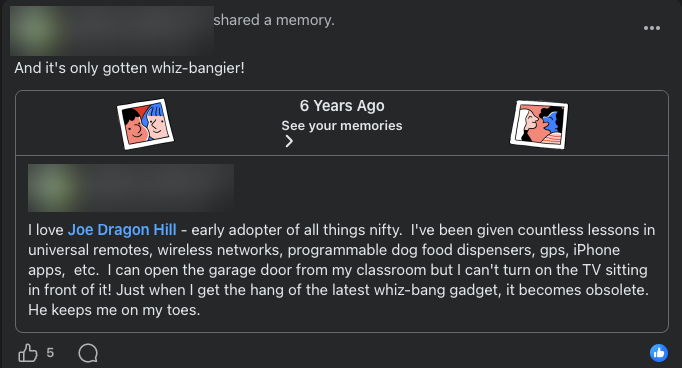
Exhibit A — and its 2017 reshare: "And it's only gotten whiz-bangier!" The roast has sequels.
Read that garage-door line again, because it took me a decade to hear what it was actually saying: I kept building automation that impressed me and inconvenienced her. Tech that serves the tinkerer instead of the household. The years after that post added more exhibits — like the fancy wall panel she roasted with #ialreadytriedthat. The standard response to my projects was an eye-roll with varying degrees of affection behind it.
But the blinds? On October 2, 2019, she posted this. Verbatim. I have the receipt:
"Since I'm quick to give Joe grief for his home automation experiments, it's only fair that I sing his praises when something is awesome. This device has passed the 'wife test' with flying colors. Joe added a solar powered retrofitted motor to our existing blinds. Now the blinds adjust automagically on a schedule. I'm really liking this home automation upgrade. Thanks Joe!"
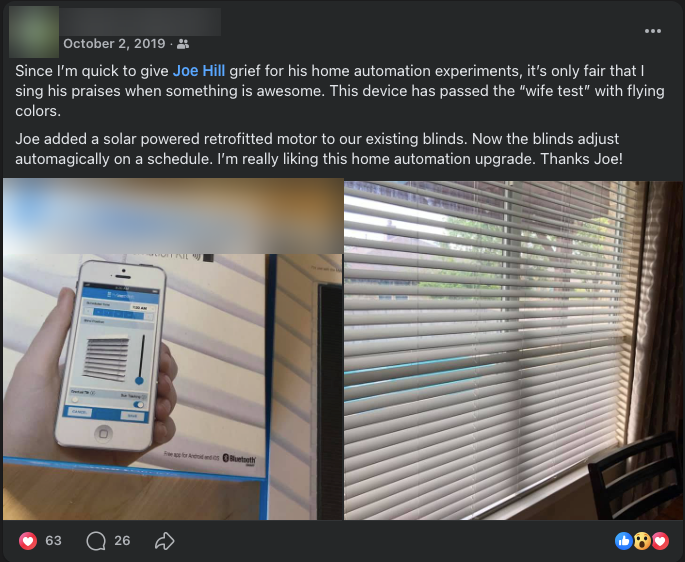
The receipt.
Sixty-three reactions. Twenty-six comments. The Wife Test isn't my marketing gimmick — it's her phrase, on the record, since 2019. And for the first time in my smart-home career, I had passed it. I retrofitted eight windows across the house. I was a hero.
Failing
Then the motors started dying.
First the two side windows in the living room — the ones flanking the big window, maximum visibility — couldn't hold a charge. Even with the fancy solar panel they sold me as the fix. Then the gears stripped: press the button, get a grinding noise, watch nothing move. One unit after another, systematically, across the house. The middle window still works to this day, which is somehow worse. It sits there between two corpses, mocking everyone.
And here's the detail that sealed my fate: those motors required removing the native cord spool to install. No cord, no manual control. When they died, the blinds didn't go back to being normal blinds — they became broken blinds. Sealed shut or stuck open, no override, nothing to pull.
My Wife Test grade was retroactively revised to a large public FAIL. The Facebook brag era was over. The eye-rolling returned with interest, now witnessed by two adolescent boys who smelled blood.
The vendor's answer was $200+ per replacement unit. For hardware I'd already bought once, warrantied some of, replaced others of, and watched fail on a schedule. That wasn't going to fly.
So: fine. I'll build my own.
The requirements wrote themselves
Everything TiltForge is came out of that failure, that week. I didn't write a product spec — the dead hardware wrote it for me:
- Manual override, always. The cord stays. If my electronics die, the blinds must still be blinds. Non-negotiable, spousal-mandate tier.
- It has to know where the blinds are — even when someone uses the cord.
- Remote control for the convenience that passed the test in the first place.
- When something breaks, you fix the part — not re-buy the product. I was never going to be on the $200-replacement treadmill again, and I wasn't going to put anyone else on it either.
That's it. That's the whole company. Everything since has been execution.
"How hard could it be?"
At the time, I figured it was easy. (Isn't that how these all start?) I'll put a servo on the end of the tilt rod and turn it to whatever angle I want. I can pull the cord with almost no effort — how much torque could it possibly take?
The servo wouldn't spin it.
Okay — bigger servo. I escalated all the way to a 25 kg-cm monster, the kind of
thing that steers RC cars the size of dogs. Nope. The archive from those weeks
is littered with the fossils — Blind Servo Mount.stl, Blind Servo Horn.stl,
MG90S servo horn to 1/4" hex rod adapter — every one of them a monument to
not understanding the problem.
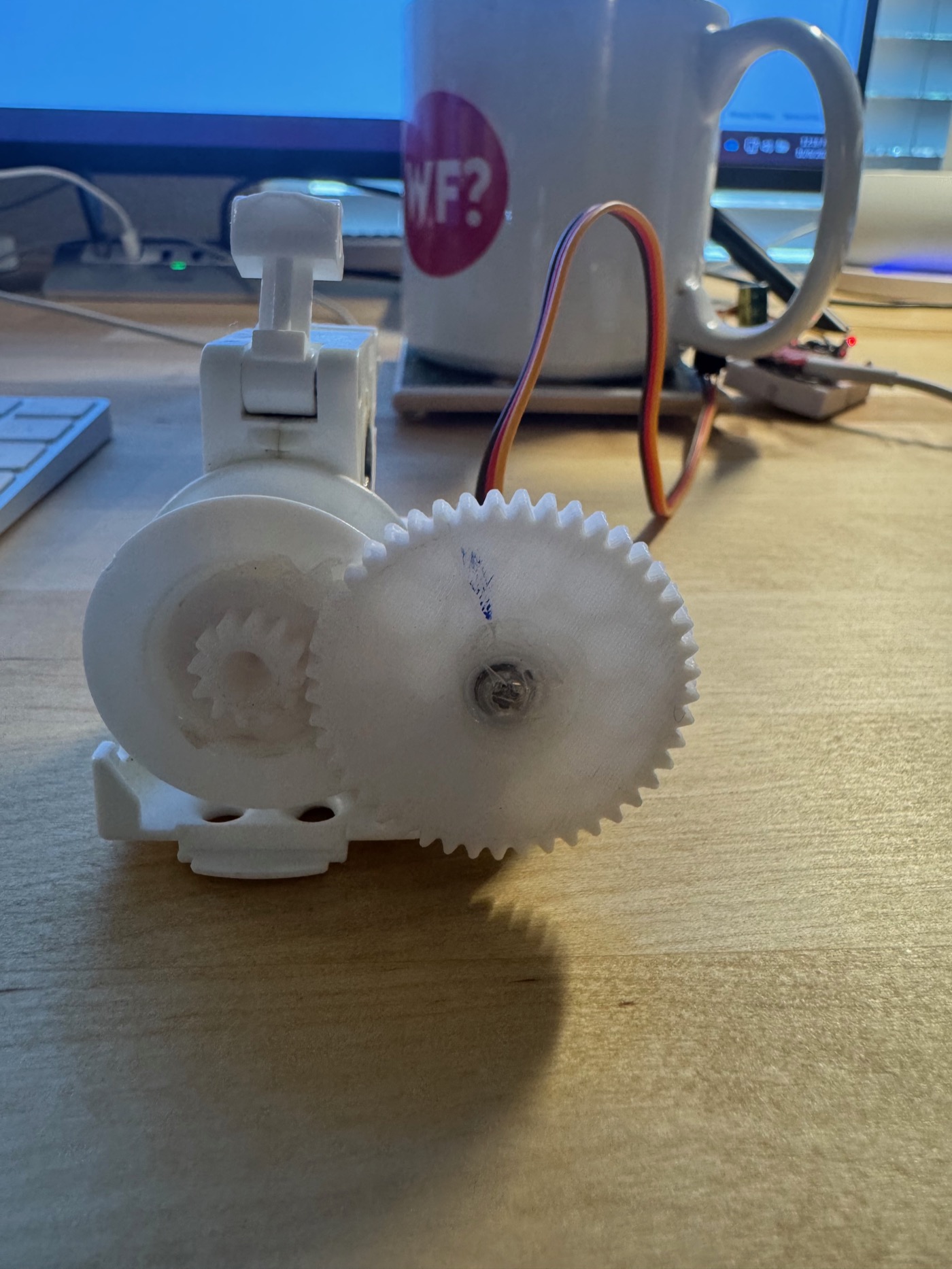
The servo era, October 8. It looks so confident.
Here's what I didn't know, that anyone with a mechanical engineering background learns in week one: worm gears are not backdrivable. Inside every blind headrail, the cord spins a little worm that drives a worm wheel on the tilt rod. Force flows one direction through that pairing — worm turns wheel, wheel cannot turn worm. That's not a defect. It's physics, it's Engineering 101, and it's why your blinds hold their angle instead of flopping shut every time a truck drives by.
Pulling the cord feels effortless because the cord is on the input side of that gearing. My servo was shoving on the output side, trying to run physics in reverse. It didn't matter how big a servo I bought. I was arm-wrestling a mechanism specifically designed to never lose that arm-wrestle.
Here's the part where I should tell you I'm an engineer. I'm not — not the shingle-on-the-wall kind, anyway. I studied electrical engineering at Texas A&M for five years and failed at it miserably. Not for lack of smarts — for lack of caring. Theory for theory's sake, math for the sake of math, never stuck no matter how hard I tried. I switched to construction science, and I've spent the twenty-five years since on the application side of electricity: working for electrical contractors, then a decade deploying controls and energy-management systems across thousands of Fortune 100 retail sites — learning how to scale, how to deploy, how to support, and living every ounce of that pain. I've built and led engineering teams without ever being allowed to call myself one. The interface between technology and the real world is where I live.
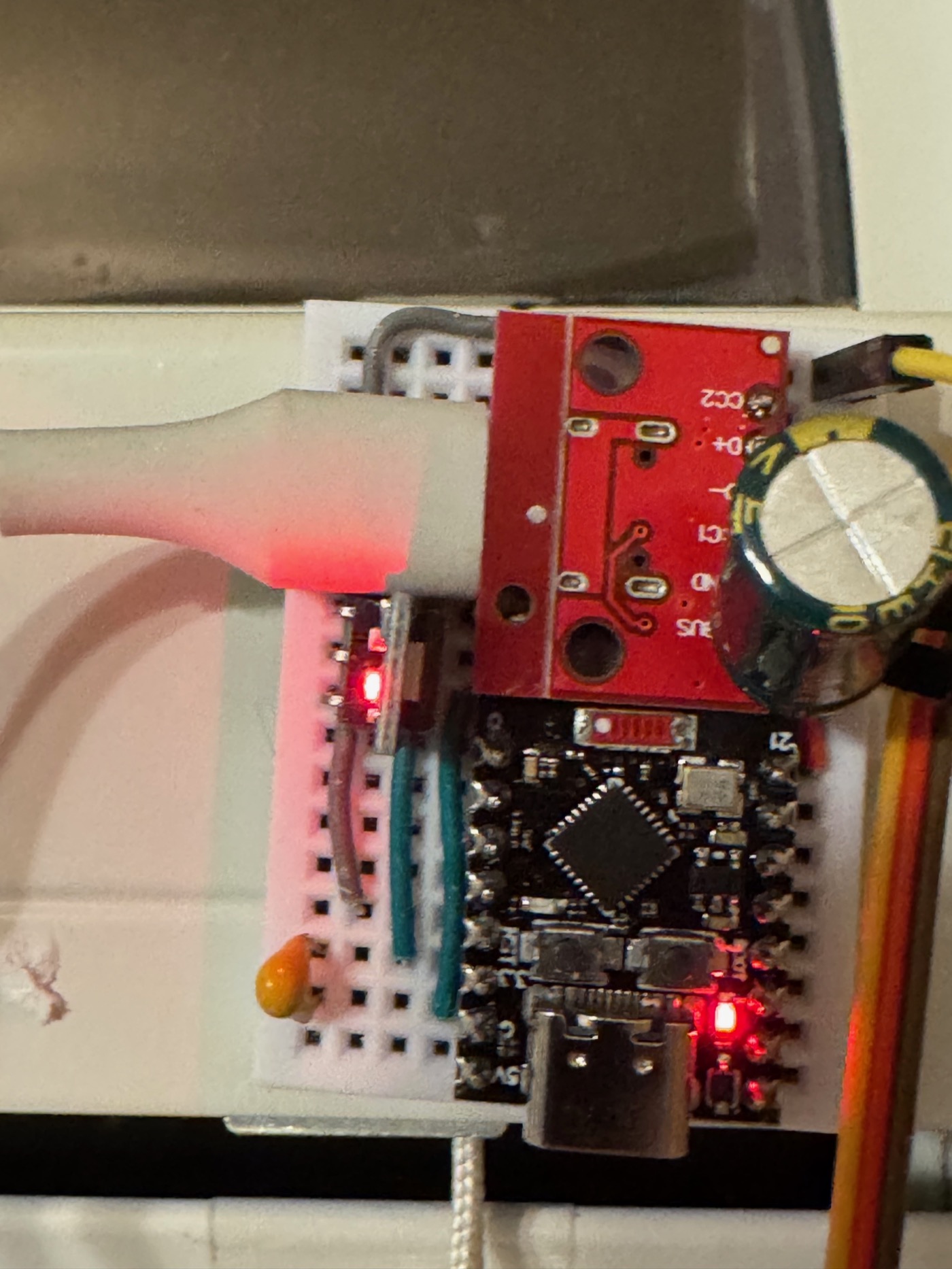
October 5: the part of the project I actually knew how to do.
So circuits, firmware, sensors — that side of this project never scared me. But suddenly I was being schooled by the caveman science of mechanics, and honestly? I was hooked. The CAD, the printing, the gear geometry — this was learning I could immediately apply, which it turns out is the only kind that's ever worked on me. The classroom couldn't teach me gear theory in 1998. A blind that publicly humiliated me taught it in a weekend. Mostly, though, I couldn't stand that I couldn't solve it. I'd made a spectacle of myself in front of my wife and both boys. There was no version of this where I didn't make it work.
The $5 part that showed the way
Funny thing: I never even tore down the failed commercial motors to see how they worked. They'd removed the pull cord. In my mind that disqualified them from existence — why study something that got the most important requirement wrong?
Instead I went the other way. I bought the native mechanism — the ordinary cord-reel tilter that lives inside a standard headrail, about $5 on Amazon — and studied that. My BOM from that month lists it, deadpan, as "test part for research."
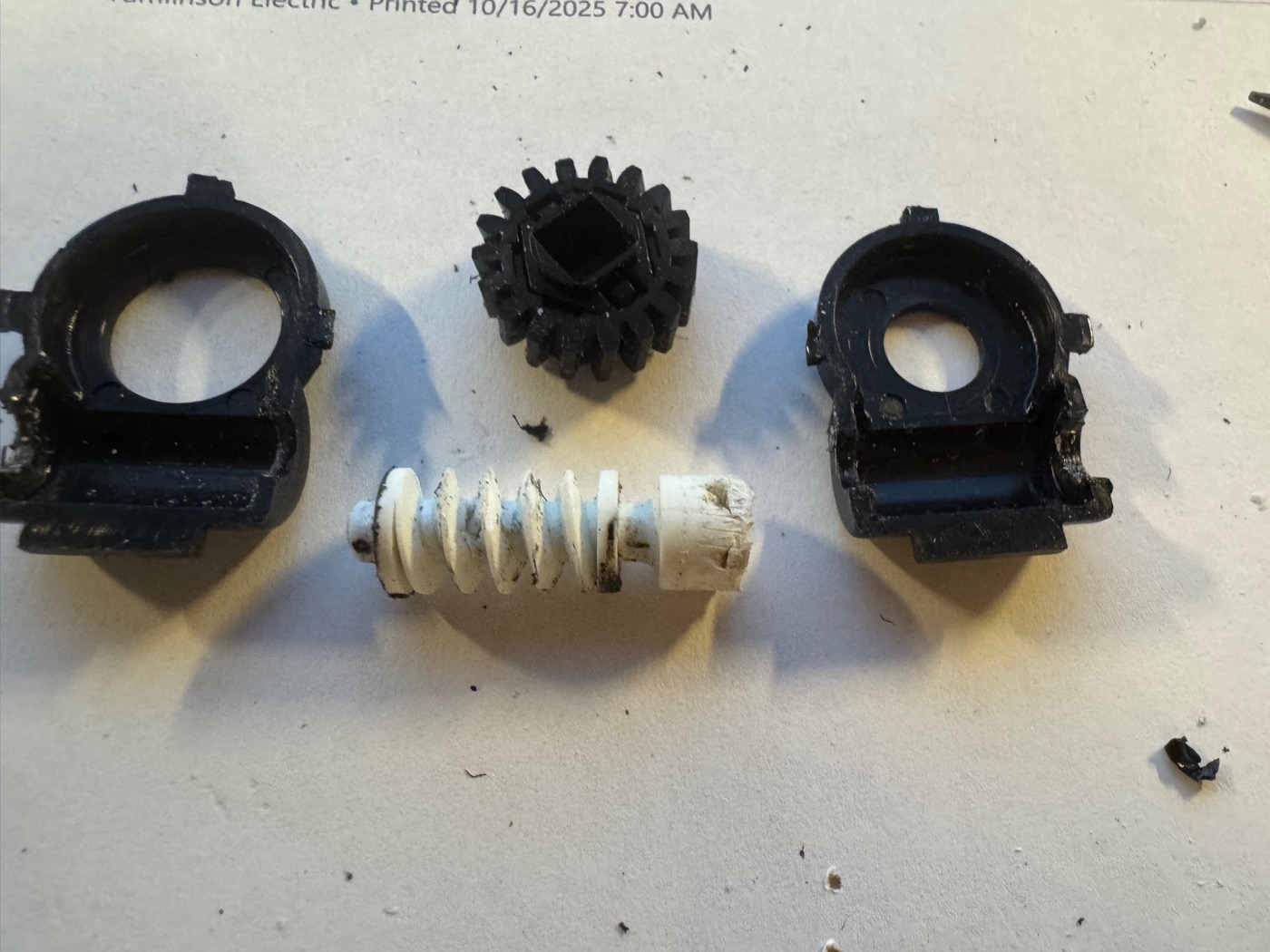
The $5 part, opened. Know your friend.
The insight: don't fight the worm gear — feed it. The cord reel already spins the axle the worm lives on. A person pulling the cord is just a torque source on the input shaft. Replace the person. Spin that axle with a motor, and the blind's own mechanism does the rest — and the cord can stay, because you're driving the same shaft it drives.
One problem: that axle doesn't stick out the other side of the tilter assembly. There's nothing to grab. Nothing to couple a motor to.
Fine, I thought. I'll print my own cord reel with an extended axle. How hard could it be?
(You may be noticing a pattern.)
It turns out the native mechanism's gear teeth are about module 0.5 — teeth well under a millimeter deep — and PLA on a hobby printer simply does not print them. My spreadsheet has the tombstone, verbatim: tiny brass worm gears, "ultimately not used because modulus was too small (like 0.5)." $9.73 of tuition. To use printable teeth I'd need a bigger module, which meant different gearing, which meant designing my own gear train, which meant —
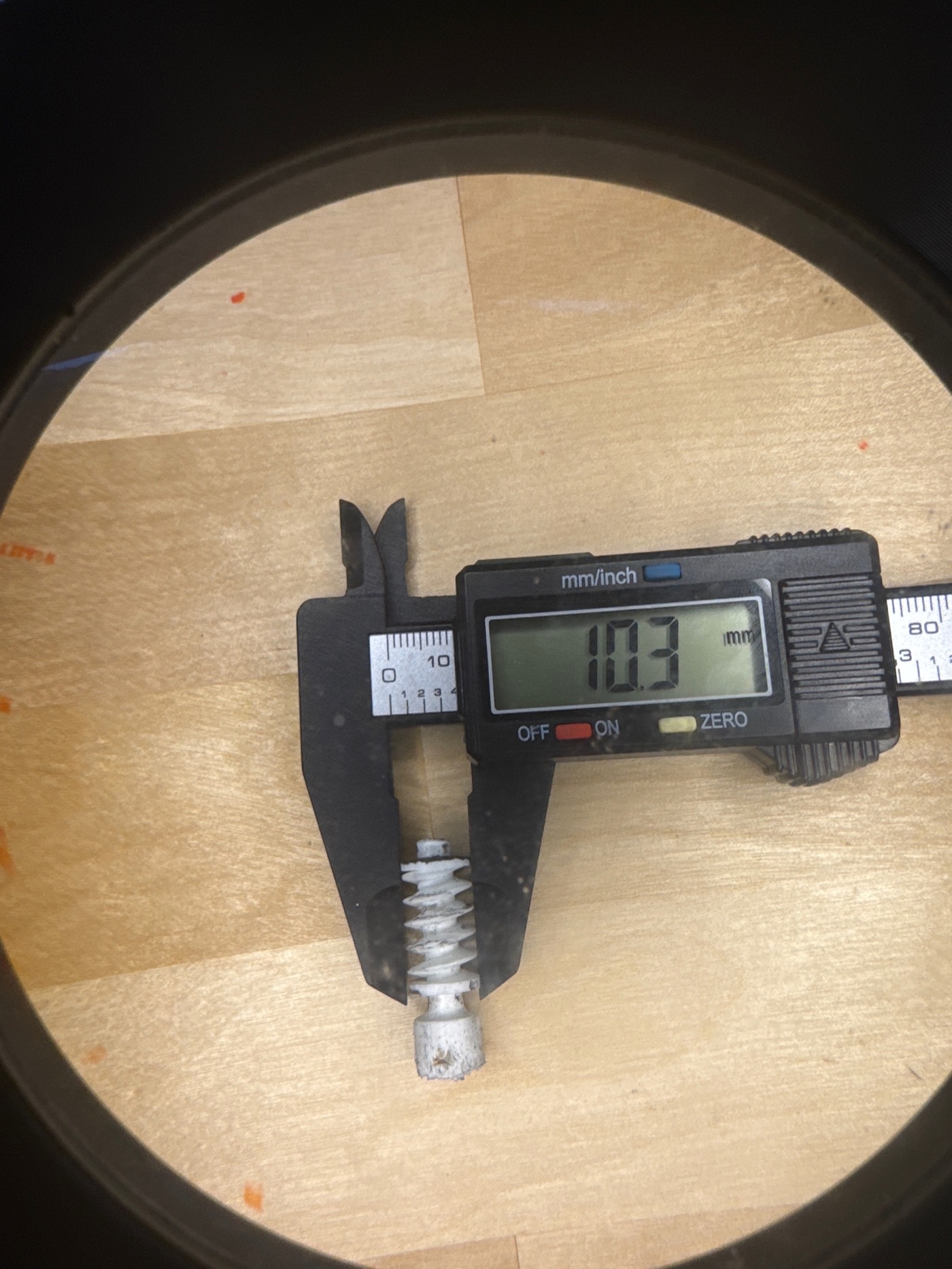
Measuring. Always measuring.
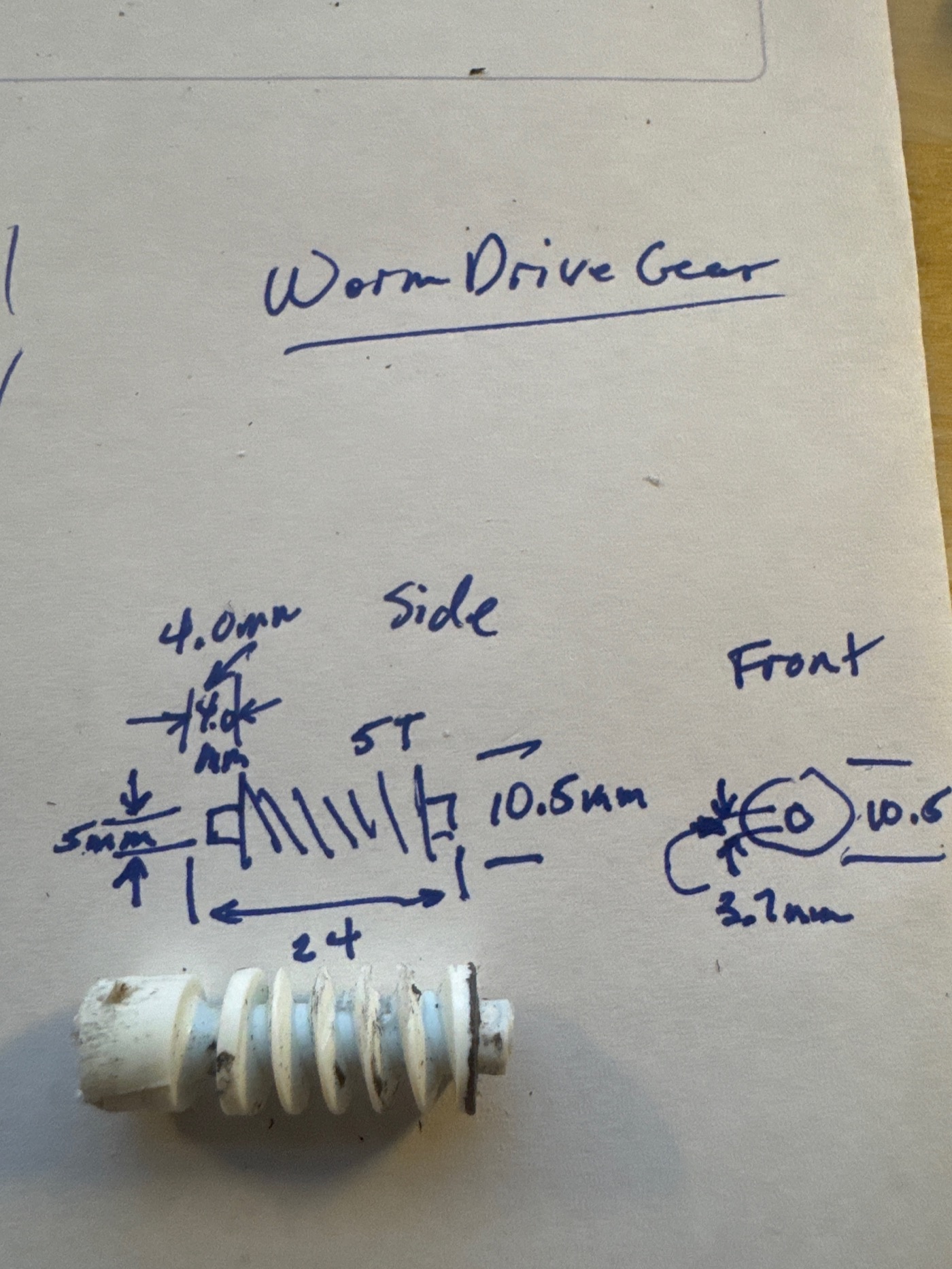
Reverse-engineering by hand: every dimension of the native mechanism, written down with the parts sitting on their own drawings.
Which meant the gearbox was now the project. October 19, 2025: the first dated folder in the archive. Five STLs of worm gears, already on revision 4.
The Facebook brag was October 2019. The first build folder is October 2025. Six years, almost to the month, from passing the Wife Test to starting to build the thing that could pass it permanently.
The spreadsheet of optimism
That first month's Amazon order — about $190 — is the most honest document I own:
- ESP32-C3 dev boards — the brain. This part I actually knew how to do.
- A3144 Hall-effect sensors, 20-pack — requirement #2, position sensing, in the cart from day one.
- L9110S motor drivers — six, at $1.50 each.
- A 6V 200 RPM gearmotor — BOM note, verbatim: "Great motor, 200RPM at 6v. A little noisy though, but works."
- Light-activated superglue — with a note calculating it was "most likely enough glue for 100 sensors (at least)."
Read that last one again. Zero working prototypes. Buying consumables at quantity one hundred. Three separate line items in that spreadsheet have per-unit-cost math at 100 devices — production planning by a guy who had just learned, that same month, what "module" means. I'd like to call it vision. It was probably just how my brain copes with uncertainty: buy the bulk pack, force the future to happen.
The "Not used" graveyard rows tell the rest: four kinds of servos (the era's tombstones, ~$70), a 70 RPM motor — "quiet, but orientation wrong" — and graphite lube: "not used and messy." No further comment.
Total month-one tuition, graveyard included: about $233. Cheaper than one semester of the mechanical engineering degree I was clearly speed-running on YouTube at 11pm.
Where this is going
By November I had a worm drive that sort of worked, a motor that was too loud, Hall sensors with nowhere to live, and a growing understanding that I hadn't signed up for a weekend project — I'd signed up for an apprenticeship.
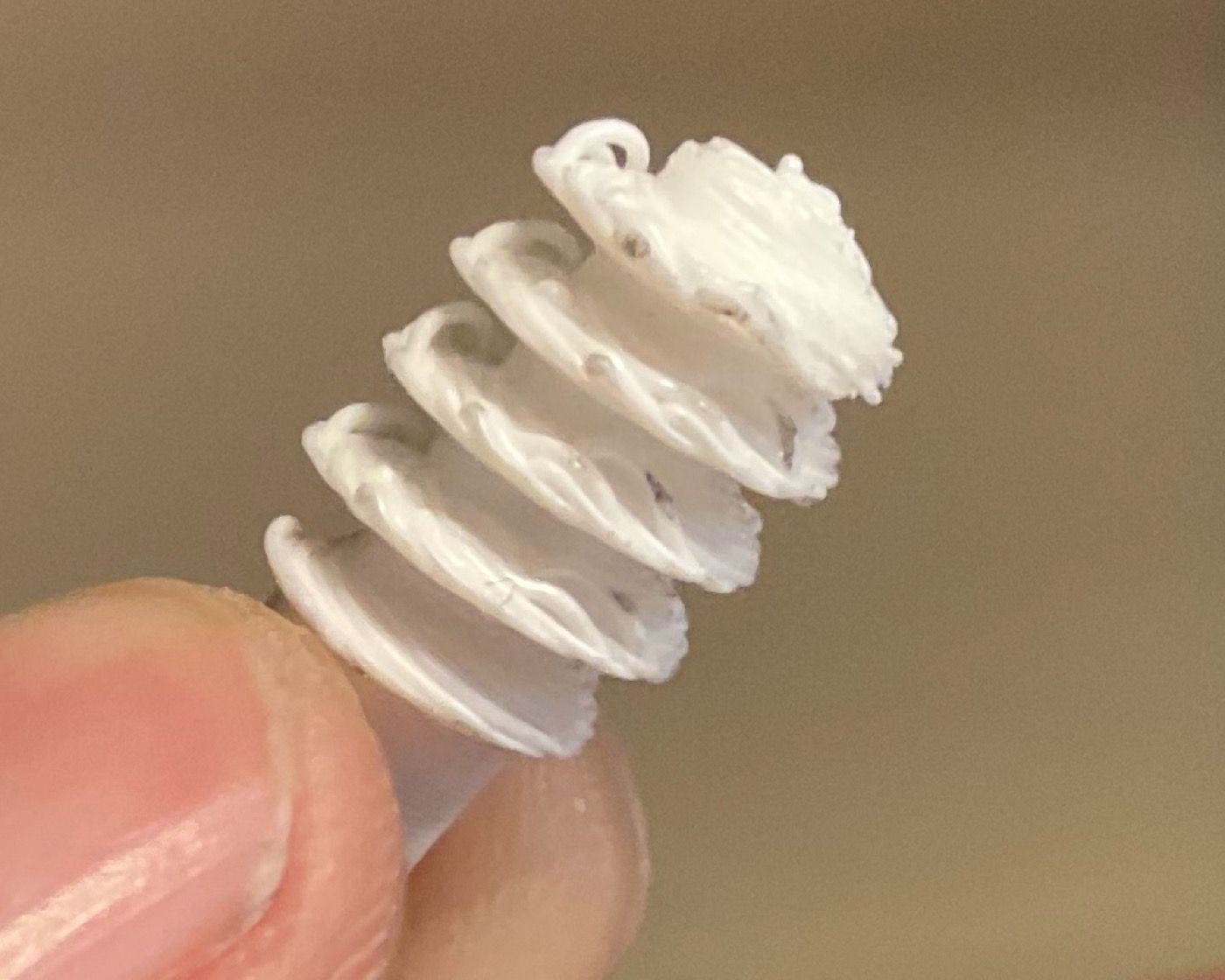
One of the first printable worms. Rough, stringy, mine.
Eight months later: the problem is solved, the design is real, and boards are on the bench. The blinds tilt from the phone, the cord still works, and the system knows the angle either way.
I should be honest about what my wife has seen of all this, because it isn't the working unit. She's seen every failed iteration — because every iteration produced an artifact that technically did something, and every single time I carried it out of the office and showed it off, proudly, prematurely, fishing for praise. None of them worked. Not really. There's a version of me in this house that has announced some form of "it's basically done" more times than anyone should get away with, to an audience that learned long ago to just nod.
So the Wife Test rematch, scheduled for September, will be played against a skeptic with seven years of documented evidence and a houseful of my confident failures. Exactly how it should be.
One more thing. Over lunch today I asked her whether I could quote her Facebook posts in this series. She said yes. She stands by every word of them. She didn't say she's still pissed about the blinds.
She didn't have to.
Good. That's the standard. That's the test.
Next post: the gear-reduction safari — planetary gears, print-in-place experiments, the day I paid a machine shop $19.27 to sanity-check my worm gears, and the harmonic-drive rabbit hole I fell into for sixteen straight days in December.
The TiltRod, by TiltForge, is a retrofit smart blind motor — repairable, open, Matter-native, and the cord always works. Pre-orders are open now with founders pricing on the first 100 units; beta units ship September: tiltforge.com/products
TiltForge — a retrofit smart blind motor. Repairable, open, Matter-native, and the cord always works.
Follow the build — new entries straight to your inbox