The Gear Safari
Post 2 of the TiltForge build journal — in which I can't figure out how to motor-drive a worm gear, so I audition every other reduction architecture in mechanical engineering, one printed failure at a time.
Where we left off
By November I had printable worm geometry — enough to keep iterating, not enough to stop hunting. What I couldn't figure out was how to drive it with a motor. The motor was too loud, the Hall sensors had nowhere to live, and every failed coupling sent me looking for a replacement architecture instead of the coupling itself. The gearbox had quietly become the whole project. If you missed how we got here, post 1 covers the Wife Test, the $5 native tilter, and the moment I realized I wasn't fighting the worm gear — I was trying to print one.
The planetary detour
The worm geometry was getting there. The motor coupling wasn't. And that gap is kryptonite for a guy who just discovered OpenSCAD gear generators at 11pm.
So I tried to replace the worm entirely.
Planetary gearing promised what I actually needed: a big reduction ratio in a small package. Sun gear, planets, ring, carrier — the whole solar system, printable, compact, elegant. The November folders fill up fast: suns, planets, rings, carriers, print-in-place experiments, a split-ring variant I was convinced was the clever one. Every folder name sounds like a breakthrough. Most of them aren't.

This is the animation that starts a thousand 11pm CAD sessions. Ring fixed, sun in, carrier out — big reduction, tiny package. Look how compact. Look how elegant. The animation never shows you the tolerances. (Animation: Jahobr, Wikimedia Commons, CC0)
In hindsight, planetary never would have worked. Not in this footprint. Not in this orientation. Even if I'd somehow gotten the ratio and the teeth to cooperate, there was a requirement I'd keep forgetting until it was too late: the cord reel has to spin. Manual override isn't a feature you bolt on after you pick a gear architecture — it's a constraint that eliminates whole categories of clever. A planetary stack has no natural place for the native spool. I was designing gearboxes for a blind that still had to be a blind.
The November folders prove I hadn't accepted that yet. Too many parts, tolerances stacking badly, every revision meaning four or five interdependent prints instead of one worm and one wheel — and the whole stack growing past what a 2.5" headrail will tolerate. I could get the math to work on paper and then hold the printed carrier next to the native tilter and feel the answer getting further away, not closer.
But by late November the folders were already changing names again, and I had a new obsession.
The $19.27 reality check
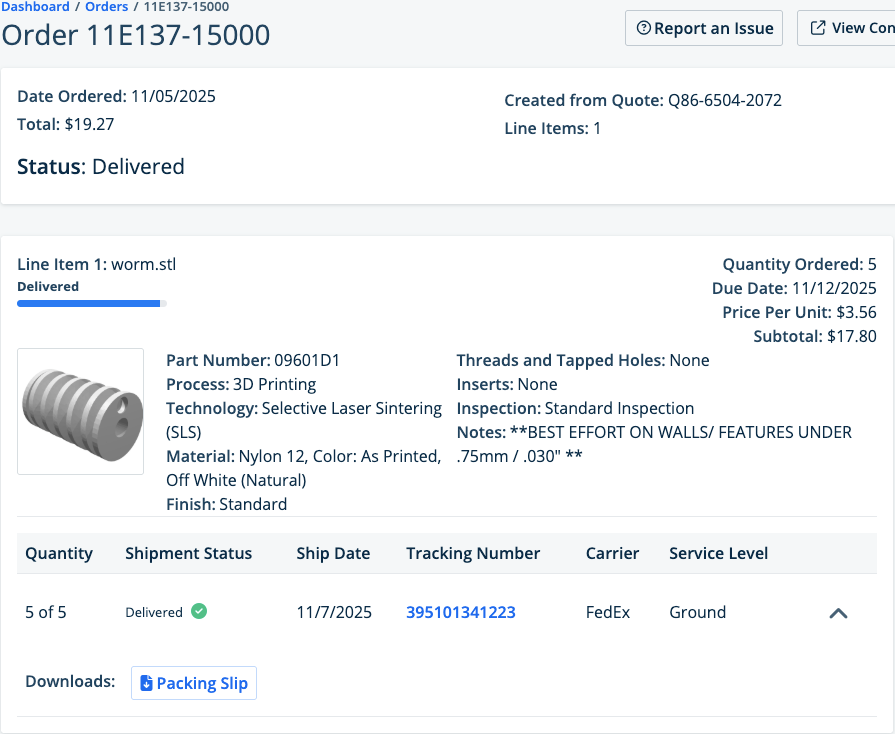
The one and only outsourced order: five professionally printed worms, $3.56 each. Note Xometry's warning — "best effort on walls/features under .75mm." Even the pros flagged the teeth.
On November 5 I placed my one and only Xometry order: five SLS Nylon-12 worms, $19.27 delivered. A sanity check. Maybe the problem was my printer, my settings, my filament — not the geometry. Let a machine shop print the hardest part in the drivetrain and find out.
They arrived in two days. I barely tested them.
Not because they were bad — I honestly don't know, because by the time the box showed up I had already moved on. Module and sizing had changed so fast in those two weeks that the professional worms were artifacts from a design I'd already abandoned. The quote PDF even carried the warning: best effort on walls/features under .75mm. Even the industrial print shop looked at my teeth and hedged.
That's the real lesson from the $19.27 reality check. If you're iterating faster than outsourced parts can arrive, the bottleneck isn't print quality. It's that you haven't stopped long enough to decide what you're actually building. I paid a machine shop to answer a question I'd already replaced with a new one.
Sixteen glorious days of harmonic drive
December 1 through December 16 — sixteen days, per the folder dates, and I won't pretend they weren't glorious. Harmonic Drive V1, V2, V3, V4, V4.1. Flexsplines, wave generators, shim plates, PETG print plates. The archive tracks a man refusing to accept that a 3D-printed flexspline is a consumable part.
And I'll be honest: it was incredible to watch one work. The flexspline engaging, the wave generator doing its thing — harmonic drives are magic if you've never seen one run. For a little while I was sure I'd found the answer.
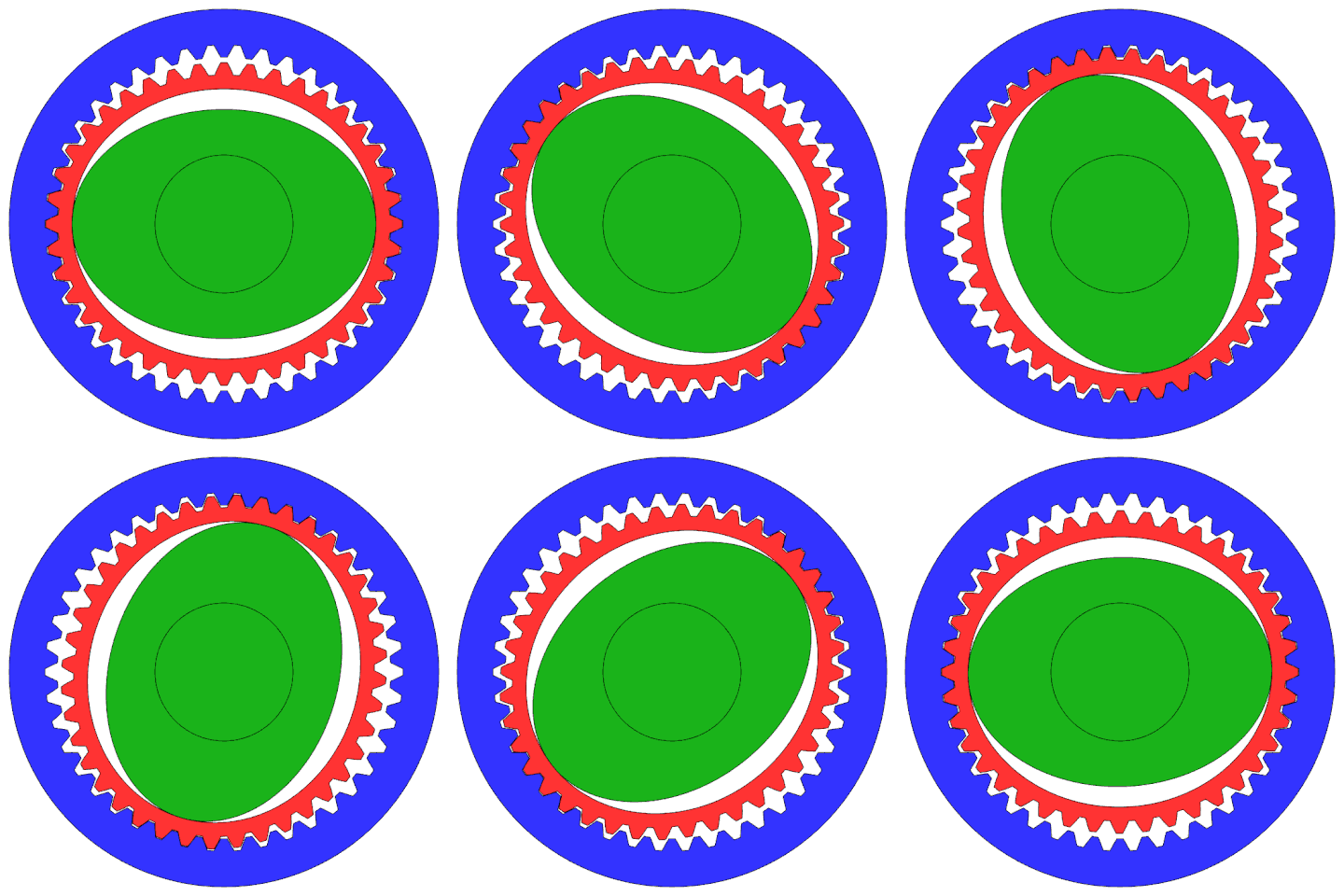
The magic, in three parts: the green ellipse (wave generator) is the input, flexing the red cup (flexspline) against the fixed blue ring. The flexspline has two fewer teeth than the ring, so every input revolution walks the output forward just two teeth — an enormous reduction with almost no parts. Watch it loop a few times. Now you know exactly how I lost sixteen days. (Animation: Jahobr, Wikimedia Commons, CC0)
Then reality showed up with a clipboard.
- Fitment. I couldn't reconcile the harmonic input with the motor offset on the shaft — the geometry that made the drive beautiful made it incompatible with everything else I'd already committed to.
- Size creep. Each revision got physically larger while the headrail stayed exactly the same size.
- Torque budget. A harmonic drive wants more torque at the input than my little gearmotor was willing to give.
- The cord spool. The requirement I'd been treating as optional crashed the party. Keeping manual override meant the native reel had to stay in the stack — and that was never in the harmonic-drive plan. It was an afterthought I hadn't earned yet, and once I tried to add it, the whole architecture groaned.
A harmonic drive is a beautiful answer to a question a window blind never asked.
Sixteen days. Four and a half versions. A flexspline graveyard. And one clear memory of the thing actually turning before I admitted what the folders were already telling me.
The pragmatic pivot
December 17. The exotic gears vanish. The folder is suddenly humble again:
worm, spool, case, tilt rod assembly.3mf. No flexsplines. No wave generators.
No solar systems.
The emotional beat wasn't exhaustion — it was clarity. I'd been chasing the wrong question. I kept coming back to the worm because the worm was right. What I couldn't solve was how to drive it — how to couple a motor to a shaft the cord also needs to spin, without fighting the mechanism or giving up manual override.
Somewhere in the safari I'd started circling the actual answer: N20 magnets pressed into printed parts, magnetically coupling the motor to the worm — in essence the drivetrain I have now, just with magnetic gears instead of a friction clutch. A friction clutch, at the time, felt like giving up. Too simple. Not engineered enough. I wasn't ready for it yet.
Maybe I should have given up on the safari sooner. I'm comfortable saying that now. But I'm no longer questioning where I landed. It has to be this way — worm, spool, cord, a coupler that slips before anything strips. The alternatives weren't worse because I executed them badly. They were worse because a window blind was never going to be the right application for them.
The project gets a name
December 20: a new file appears in the archive — v1 TiltRod.stl.
Lucas: "The first thing you need is a name. Then you'll know what kind of band you've got."
Early naming is part of the design process for me. A project needs a personality at the beginning — you have to know what kind of thing you're building before the specs settle. I'd already been sketching TILTFORGE in my head (yes, all caps, bold — that's the one that stuck), and TiltRod felt like the right name for the mechanism itself. Room to grow, if I ever expanded to a TiltShade or a TiltShutter. Mostly it was about staying inspired and flexing neurons that CAD alone doesn't touch.
What the safari taught me
I didn't waste two months. I bought two months of certainty — even if I probably could have arrived at the answer sooner.
Every gear architecture I could name got an audition: planetary, split-ring planetary, outsourced SLS worms, four and a half harmonic-drive revisions. I kept trying to replace the worm because I couldn't figure out the motor coupling. The worm kept winning on the only scoreboard that mattered — fit, torque, cord override, and the ability to iterate at 2am without waiting on a quote PDF.
That's not failure cosplaying as research. That's how you know. You don't trust the first answer because it came first. You trust it because you tried to kill it and couldn't — and then you finally stop trying to replace the part you needed and start solving the part you were avoiding.
The gearbox was always the project. November and December just made me stop pretending otherwise. And the coupling — magnetic gears, then a friction clutch I was too proud to accept — was the real homework all along.
Next post: magnets designed into the drivetrain, seven motor-mount revisions over New Year's Eve, and a KiCad folder that appears on January 1st — the day the printed toy gets a schematic.
The TiltRod, by TiltForge, is a retrofit smart blind motor — repairable, open, Matter-native, and the cord always works. Pre-orders are open now with founders pricing on the first 100 units; beta units ship September: tiltforge.com/products
TiltForge — a retrofit smart blind motor. Repairable, open, Matter-native, and the cord always works.
Follow the build — new entries straight to your inbox