It Gets a Brain
Post 3 of the TiltForge build journal — the sensing problem I couldn't put down, seven motor mounts on New Year's Eve, and the January 1st folder where the printed toy got a brain I had no business building alone.
Where we left off
By December 17 the safari was over. Two months of planetary stacks, outsourced worms, and four and a half harmonic drives had all lost to the same humble pairing I'd started with — a worm, a wheel, and the cord that has to keep spinning. Post 2 is the whole embarrassing tour, right down to why the harmonic drive was a beautiful answer to a question a window blind never asked. The mechanism even got its name that week: TiltRod.
So the architecture was settled. What wasn't settled was everything that makes an architecture into a device. Two problems walked into the back half of December with me, and neither one had a clean answer yet: how does this thing know where the blind is, and how do you actually drive it without fighting the mechanism or the cord.
This post is those two problems, and the day I stopped pretending the second half of the project — the electronics — was going to be the easy half.
The sensing problem I couldn't put down
Requirement #2, since the very first failure that started all of this: the blind has to know its position, even when a human moves it by the cord.
That sounds simple until you try to build it. December 19 through 21, three
files show up in the archive — magholder.stl, magspur.stl,
mag shield 2.5.stl — the first time position sensing stopped being something I
figured I'd glue to a housing later, and started getting designed into the
moving parts.
Here's the trap I was in. Every drive I'd built needed the input to spin multiple times to move the blind through its range. So to know where the blind was, I had to count — count motor rotations, count magnet sweeps past a Hall sensor. And counting works right up until someone touches the cord. The moment a hand nudges the tilt rod, your count is a beautiful, confident lie. The firmware would swear the blind was at 40% while it sat wide open, because nobody told the counter about the hand.
I chased it sideways for a while. I found 360° continuous-rotation servos and thought maybe those were the answer — but they had the same disease. They'd tell me the shaft was turning; they wouldn't tell me where it had stopped. Relative motion, never absolute truth.
I hadn't yet arrived at the idea that eventually solves this cleanly — a single
magnet riding the worm wheel and a sensor that just reads the angle of the tilt
rod directly, no counting, no memory, no lie to catch up on. In December I was
still circling it. The mag files are me feeling around the edges of a problem I
could name perfectly and not yet close. That's most of engineering, it turns
out: knowing exactly what's wrong for weeks before you know how to fix it.
Seven motor mounts and a ball dropping
The other problem was blunter. I had a motor. I had a gear train. I could not get cleanly from one to the other.
The motor's output was a D-shaft — a round shaft with one flat milled into it — and translating that little D profile into something that drives a printed gear train, inside a 2.5" headrail, without slipping and without eating all my clearance, turned into its own saga. The archive logs it as a New Year's Eve sprint: seven motor-mount revisions between December 29 and 31. (Full disclosure — I went back to find those exact dated folders while writing this and couldn't put my hands on them. The count comes from my notes; if it was six or eight, forgive me. The point stands: it was a lot, and it was New Year's Eve.)
The way it actually went is the truest picture of how this whole project got built. I'd slip into the office for twenty, thirty minutes — tweak the mount, kick off a print — and go back out to be with my family. Come back at the next break, look at what the printer made, tweak again, print again. Bursts. Stolen half-hours around a household that, fairly, thinks I work too much.
And the entire time I had this number in my head: done by January 1st. I genuinely believed it. New year, finished machine, clean story. I had no idea I still had months of cycles ahead of me — the magnetic detour, the cycloid campaign, the 25-part machine I'd eventually delete. You don't get to know that in the moment. You just keep stealing half-hours and kicking off prints while a ball drops on a TV in the other room.
January 1st: the toy gets a brain
New Year's Day, a new kind of folder appears in the archive. Not an STL. Not a 3MF. A KiCad project — plus an L9110H-and-ESP32 breadboard netlist, sketched out before it was ever a board.
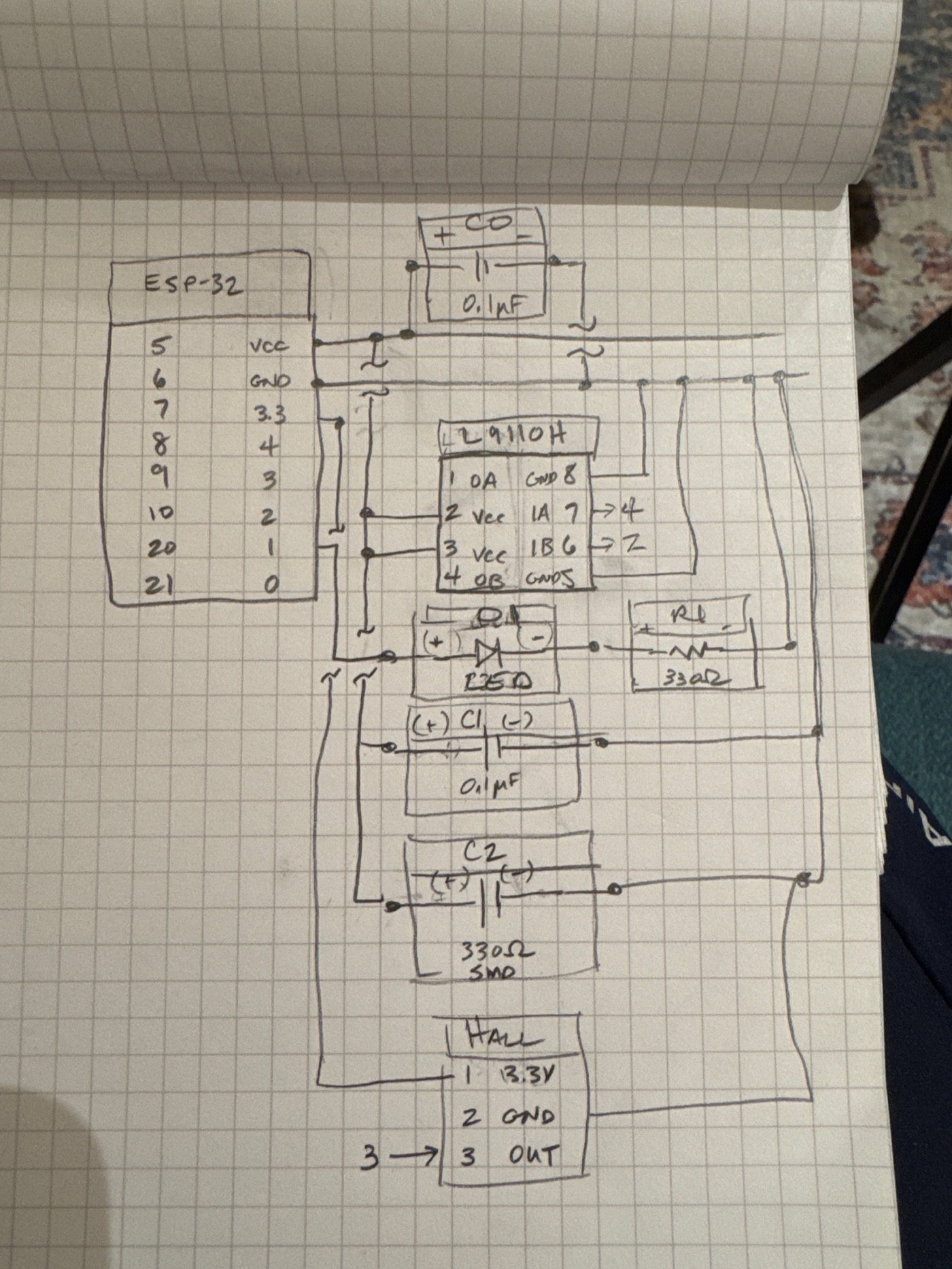
The brain, sketched by hand before it was ever a board.
Now, here's where I have to correct the story I want to tell you.
The clean version goes: after three months of getting schooled by gears, the electrical engineer finally reached the electronics and came home to easy ground. It's a good story. It's not true.
I studied electrical engineering for years — and, as I've told you, failed at it about as completely as a person can. But even setting that aside: I had never designed a PCB in my life. In a former life I ran the controls division at FSG, and I commissioned boards all the time — I knew how to specify them, spec the system around them, deploy them by the thousand. But I was always the guy pointing at the board, never the guy drawing it. I'd never been the pig and the chicken at the same time — committed and involved, both at once, with nobody else to hand the hard part to.
So opening KiCad on January 1st wasn't coming home. It was standing at the edge of something I'd spent a career adjacent to and never actually done myself.
What got me across was AI.
I'll say this as plainly as I can, because it's the honest engine under this entire project: if it weren't for AI, TiltForge would not exist. Not as a maybe. It would have died the way every nights-and-weekends idea dies — starved of the one thing a solo guy at six-to-eight hours a week never has enough of: time, knowledge, money, all three. What AI did was stitch my fragmented pieces into something whole. The scattered things I half-knew — the EE I'd absorbed and abandoned, the systems fluency from FSG, the CAD I'd been teaching myself at 11pm — got connected into deliverables that used to require an entire staff, now produced in overnight sessions by one person at a workbench.
That's not a footnote. It's the whole reason a printed toy got a schematic instead of getting shelved.
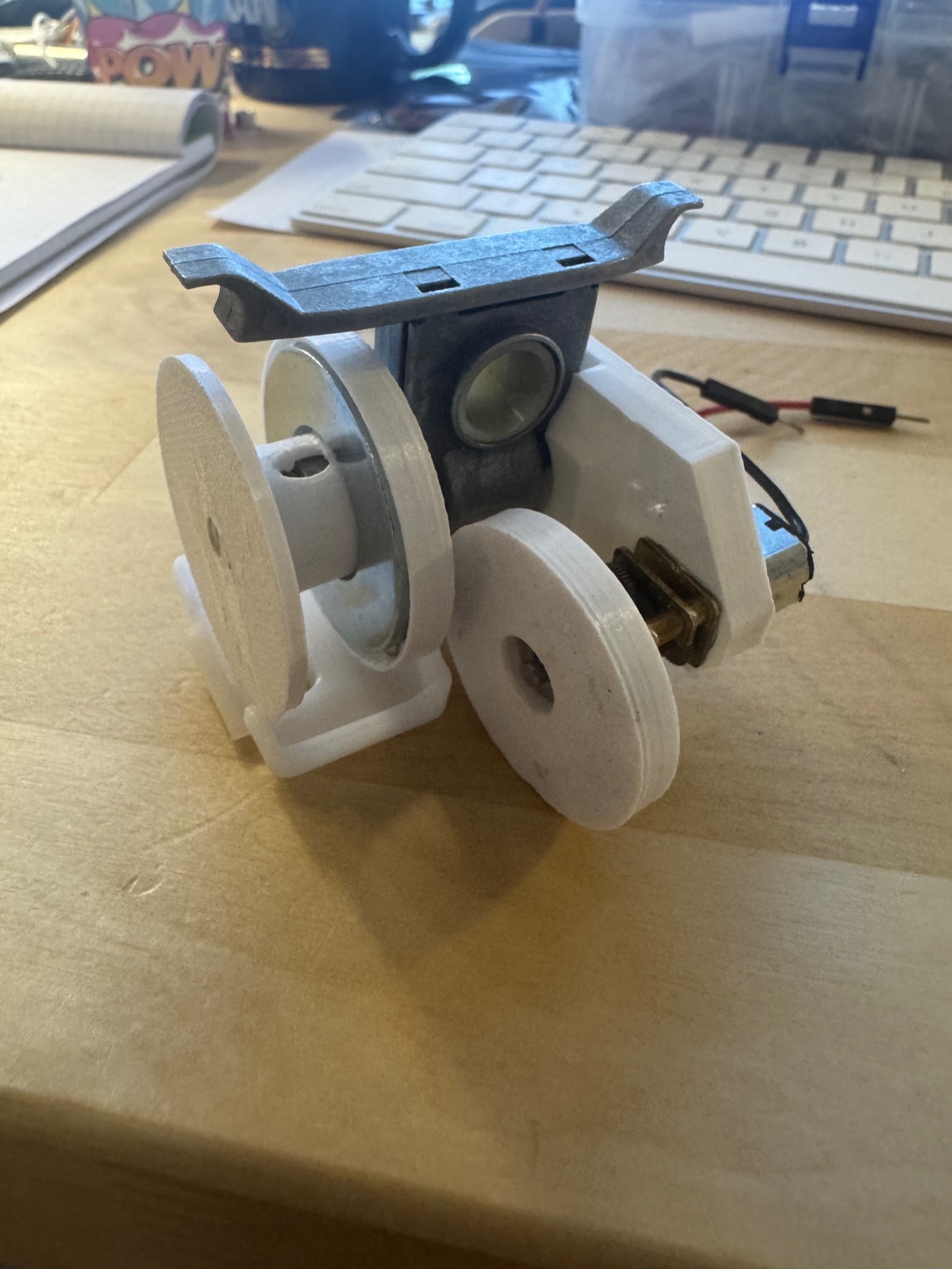
January's velocity, once the electronics had a spine: v2.5 → v3.0 → v3.6 → v3.7.1.
Because here's the thing my superpower always was — long before any of this. I was never the smartest person in the room, and I've made peace with that. What I was good at was leveraging other people's skills: finding the talent, stitching it together, pointing it at a problem. AI is that superpower with the ceiling removed. It's the thing that lets a self-described washout — a guy who couldn't hack it in the EE program, who's fixing dead blinds instead of shipping at some company — actually produce something real, by himself, at a kitchen-table budget.
That's not a threat to me. It's the most exciting thing that's ever happened to people like me.
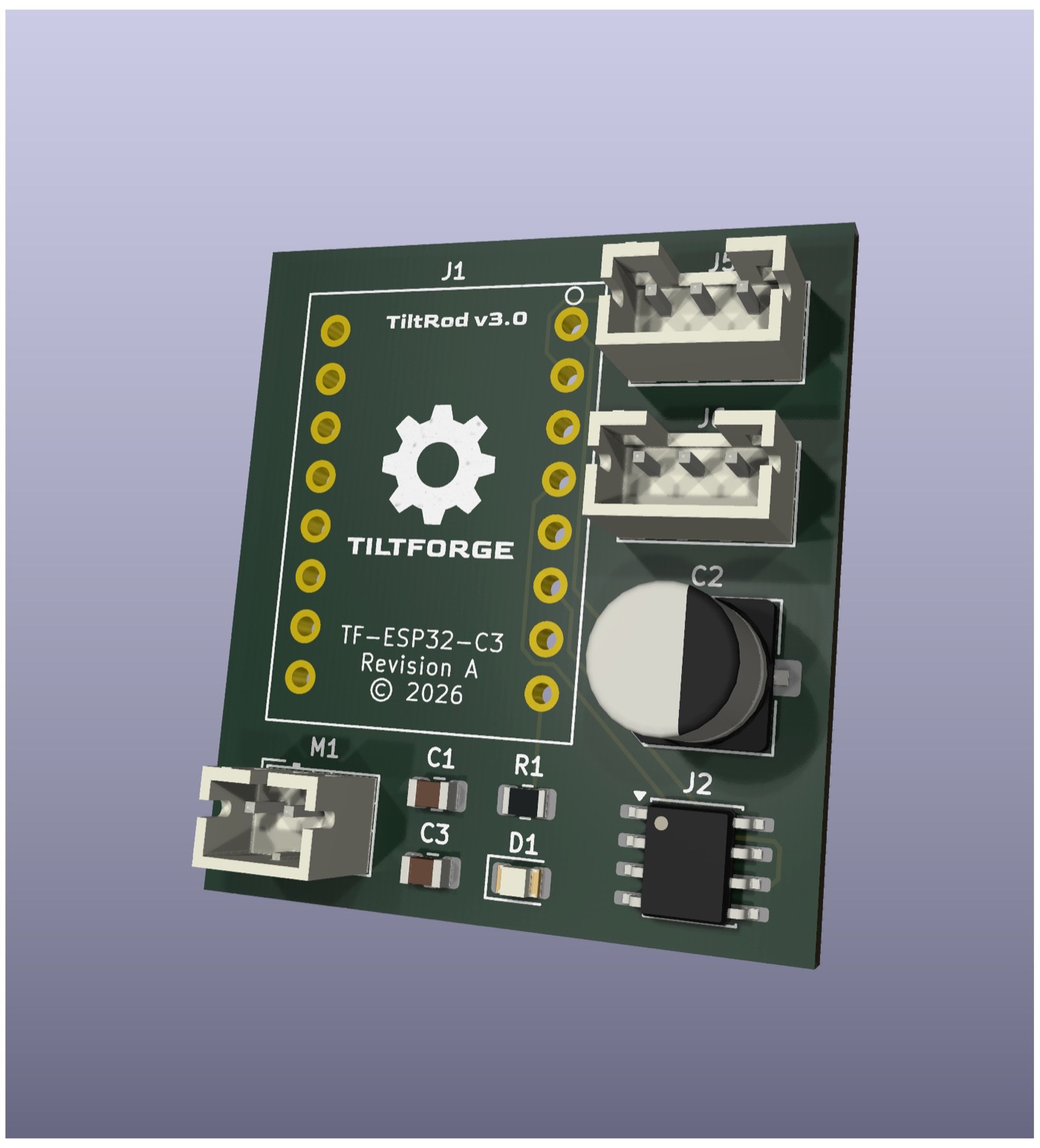
From a hand-sketched netlist to a real board layout — in weeks, not the years it would have taken me alone.
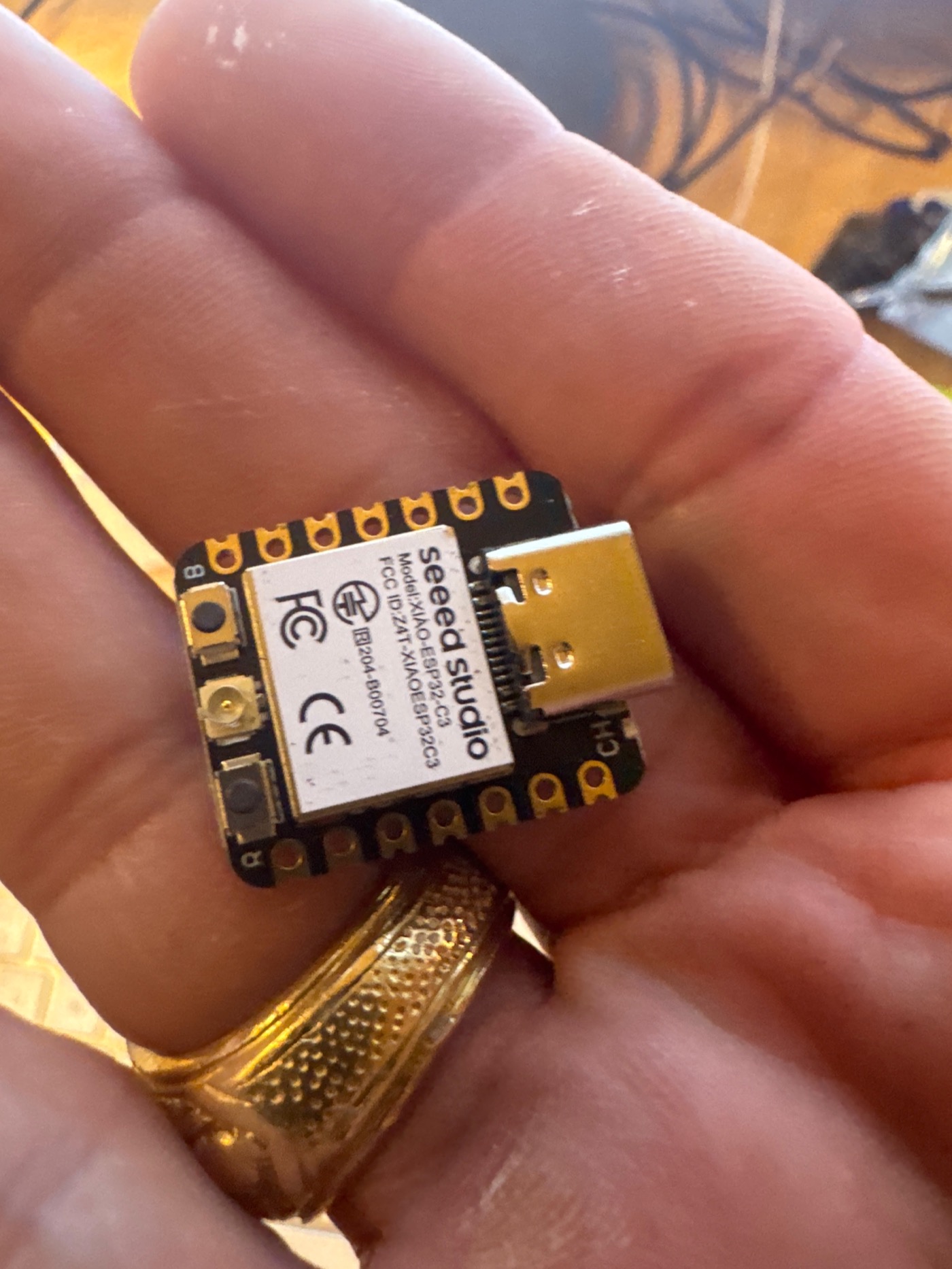
The actual brain: a XIAO ESP32 — the whole computer, smaller than the gears it drives.
What January taught me
December taught me that naming the problem is not the same as solving it — I could describe the sensing failure perfectly for weeks before I could fix it. New Year's Eve taught me that the last ten percent of a mechanism is seven brackets in a trench coat. And January 1st taught me the thing I keep having to relearn: play to the strength you actually have, and get help with the rest — without shame about it.
I didn't become a PCB designer overnight. I became a guy who could ship a PCB design overnight, because I finally had a collaborator who never sleeps and never makes me feel stupid for asking. The printed thing that turned a blind became a device that could be told what to do — even if it still couldn't reliably tell me where the blind was. That fight wasn't over.
And I still thought the hard part was behind me. It was not. February opens with the single weirdest folder in the entire archive: a gearbox with no touching parts.
Next post: magnetic gears that never touch, a friction clutch that sneaks in as a throwaway footnote, and the cycloid campaign I could not quit — the two months I auditioned physics itself.
The TiltRod, by TiltForge, is a retrofit smart blind motor — repairable, open, Matter-native, and the cord always works. Pre-orders are open now with founders pricing on the first 100 units; beta units ship September: tiltforge.com/products
TiltForge — a retrofit smart blind motor. Repairable, open, Matter-native, and the cord always works.
Follow the build — new entries straight to your inbox