Exotic Detours
Post 4 of the TiltForge build journal — February and March, in which I audition physics itself, and the most important part of the final product sneaks in through a side door.
A gearbox with no touching parts
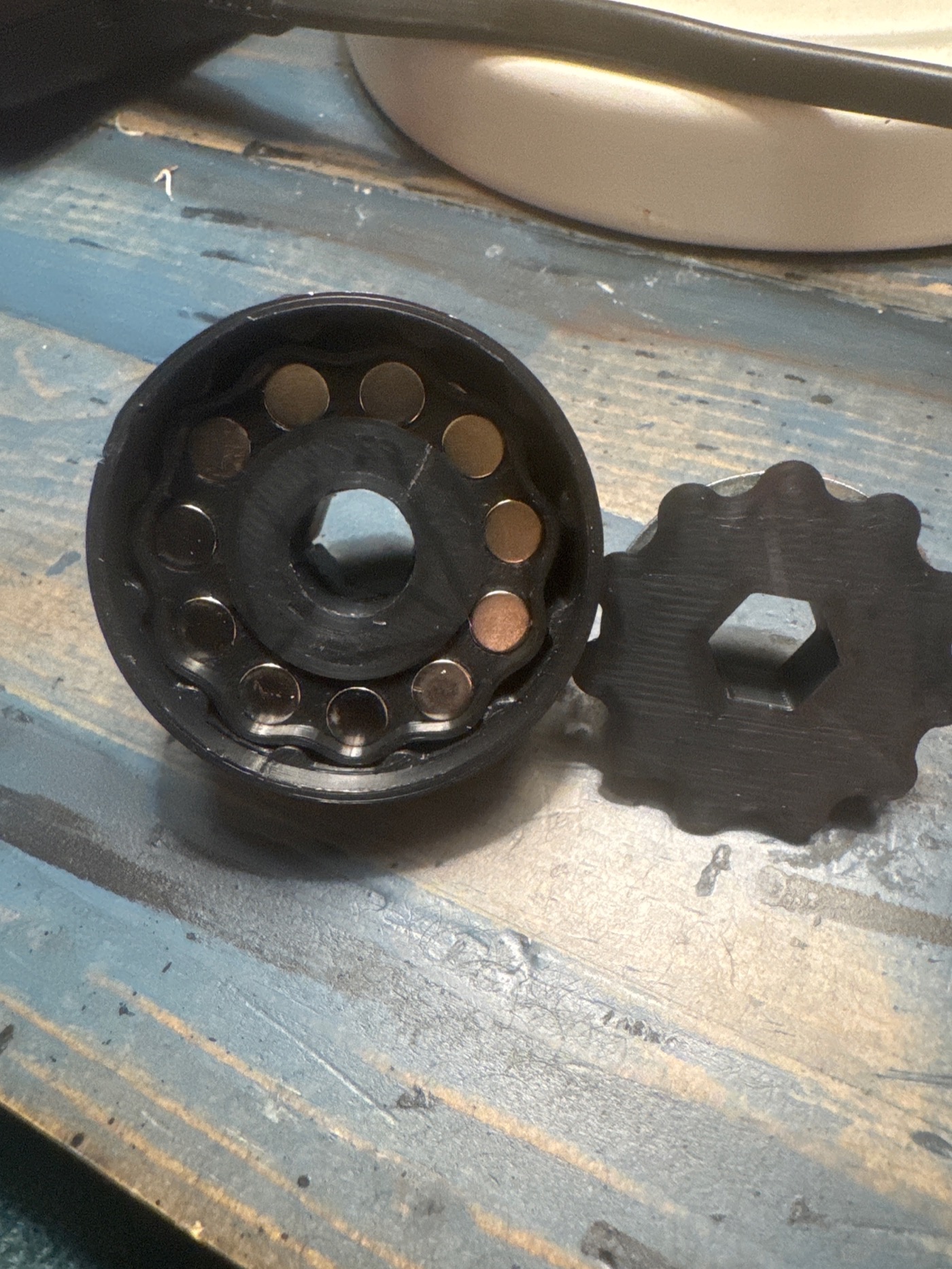
Magnetic gearing: stators, modulators, "tuned mag gears." No contact, no wear, no noise. It didn't survive the week.
The appeal was obvious: no contact means no wear, and TiltForge's whole pitch is repairability — gear teeth grinding against each other for a decade of daily use is exactly the failure mode I wanted to design around. N52 magnets looked like the answer, strong enough to transmit real torque without a single part touching another.
They were also the problem. Magnets that strong don't repel and attract cleanly along one axis — they bind. Every time the gear arms swept past each other, the field fought the rotation instead of driving it. The same strength that killed wear introduced a drag I couldn't design out. It didn't survive the week.
The footnote that became the company
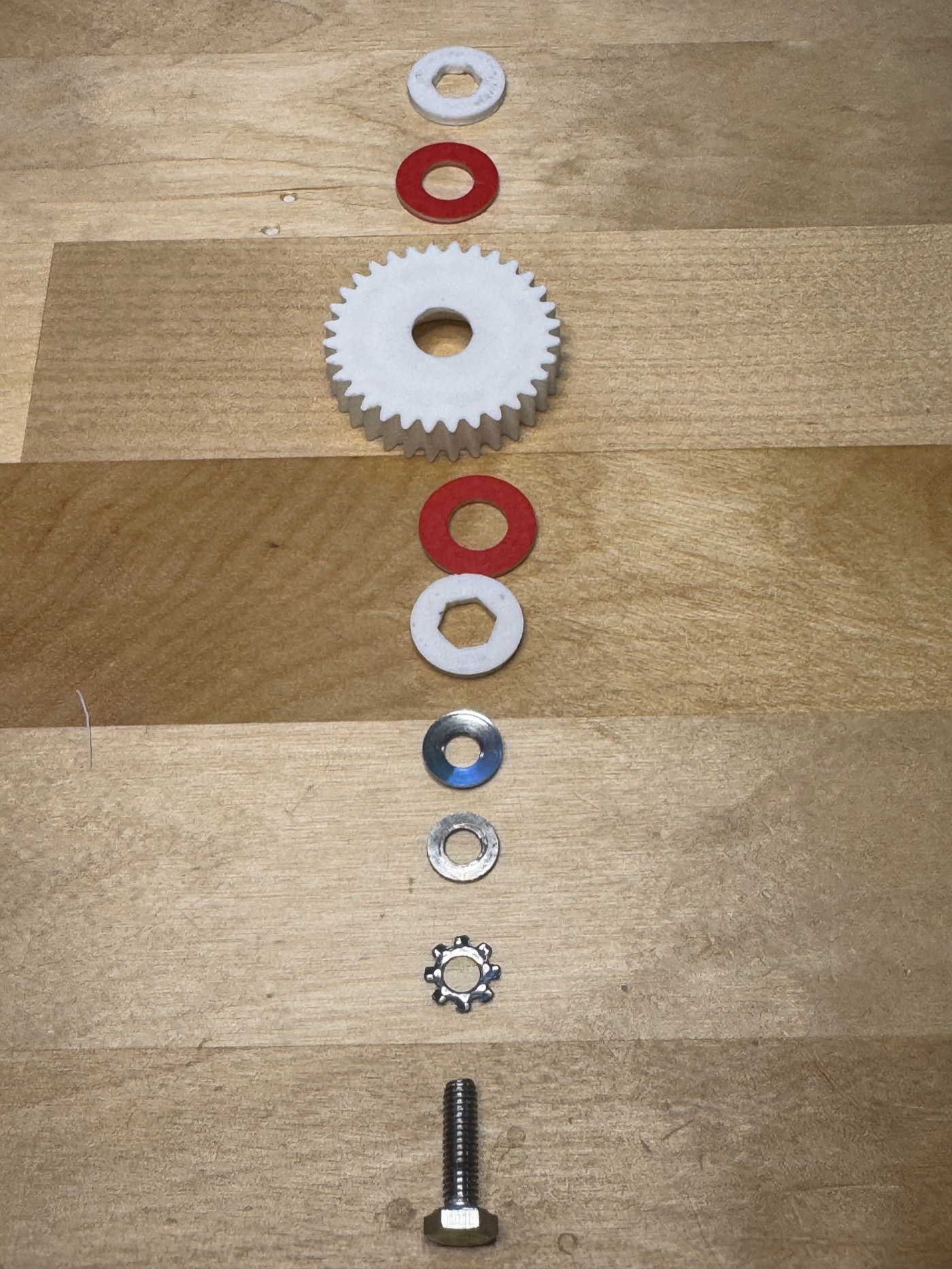
The clutch stack: gear, friction disc, spring washer — three printed parts standing in for the slip that used to be free.
There was a silver lining buried in the magnetic gear's failure: it never needed separate overload protection. When something jammed, the magnets just slipped — no stall, no stripped teeth, cord still turned by hand. That slip was free.
Once I gave up on magnetic teeth for a real modulus-0.8 gear pair — printing magnet pockets had turned out to be a lot easier than holding tolerance on 0.8 modulus teeth — I lost that safety valve. A rigid gear train fights you if you grab the cord and pull. So friction2.stl shows up in the archive on Feb 4, at the time just a patch to reintroduce the slip I'd gotten for free with magnets. I didn't know yet it would end up being the single most important part in the transmission.
Belts, bushings, and "radar" bearings
Compression rings, locknuts, TPU timing belts, printed bearings — two weeks of throwing alternate transmission ideas at the wall. TPU belts looked promising on paper: flexible, printable, no metal parts. In practice they stuck hard to the plate and never peeled clean, possibly more a printer-tuning problem than a materials one at the time. Even a clean belt had to be tensioned, and tensioning it reintroduced the same failure I kept running into: a binding force on the axles. Same enemy, different costume.
The cycloid campaign
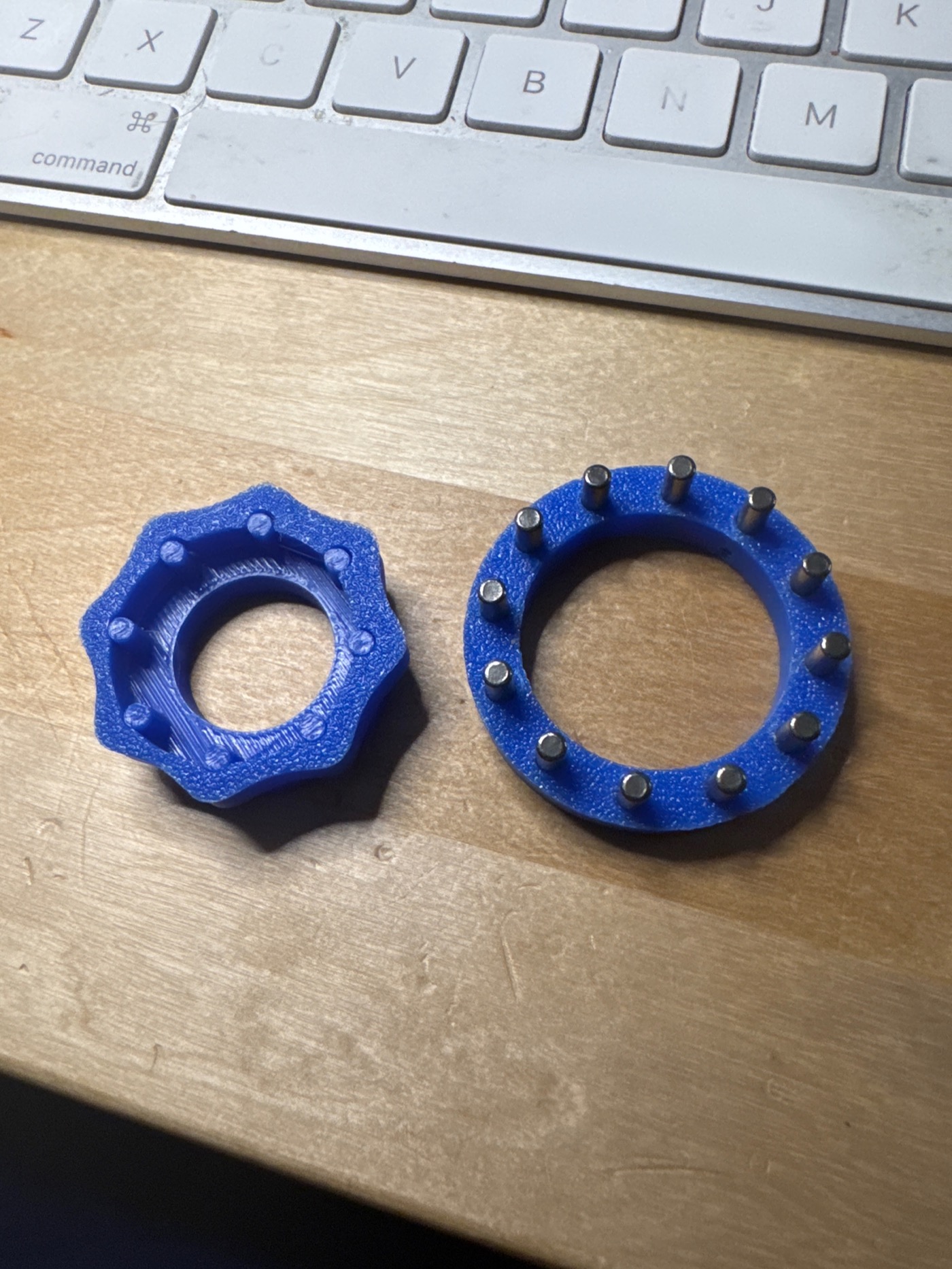
The cycloid era: eccentric cams, oldham couplers, rings full of bearings — the most mechanically sophisticated the project ever got.
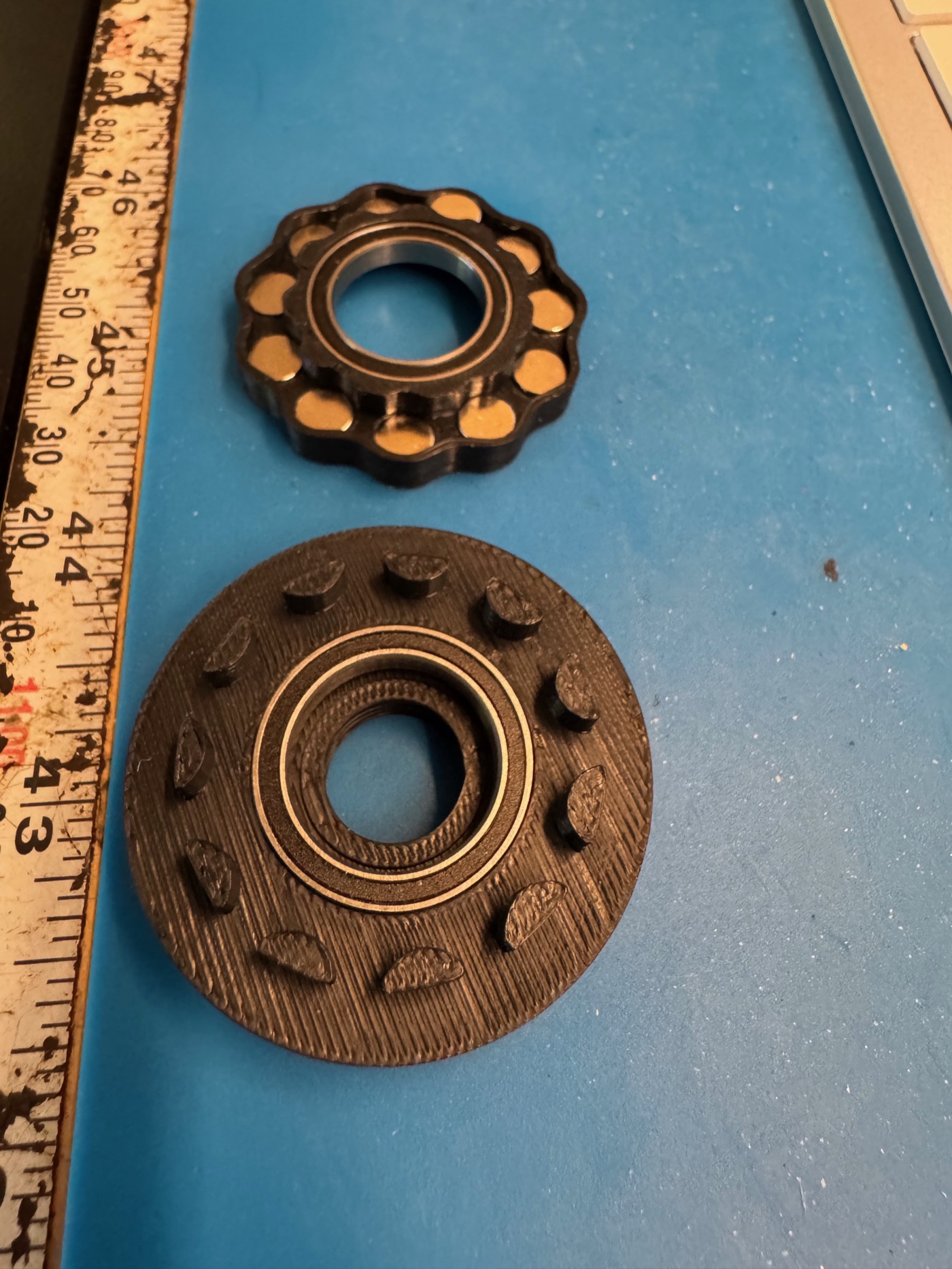
Revision suffixes appear — r1, r2 — the numbering discipline that says "this one's for real."
The cycloid drive earned its own campaign for a reason — eccentric cams, oldham couplers, rings full of bearings, the whole thing spinning without a single point of sliding friction. It's an elegant piece of mechanical design, and I got far enough to start using revision suffixes, r1, r2 — a naming discipline I only reach for when I think something's real.
What killed it wasn't the geometry. It was a requirement I'd let myself forget: the drivetrain has to keep the spool on the worm gear reduction, not drive the tilt rod directly, and a cycloid stage doesn't give you that reduction the way a worm does. I'd fallen hard enough for the elegance of the design that I designed straight past my own constraint. By the time I caught it, the whole thing needed a ground-up redesign. Stupid, avoidable, expensive.
Meanwhile, the brain grows up
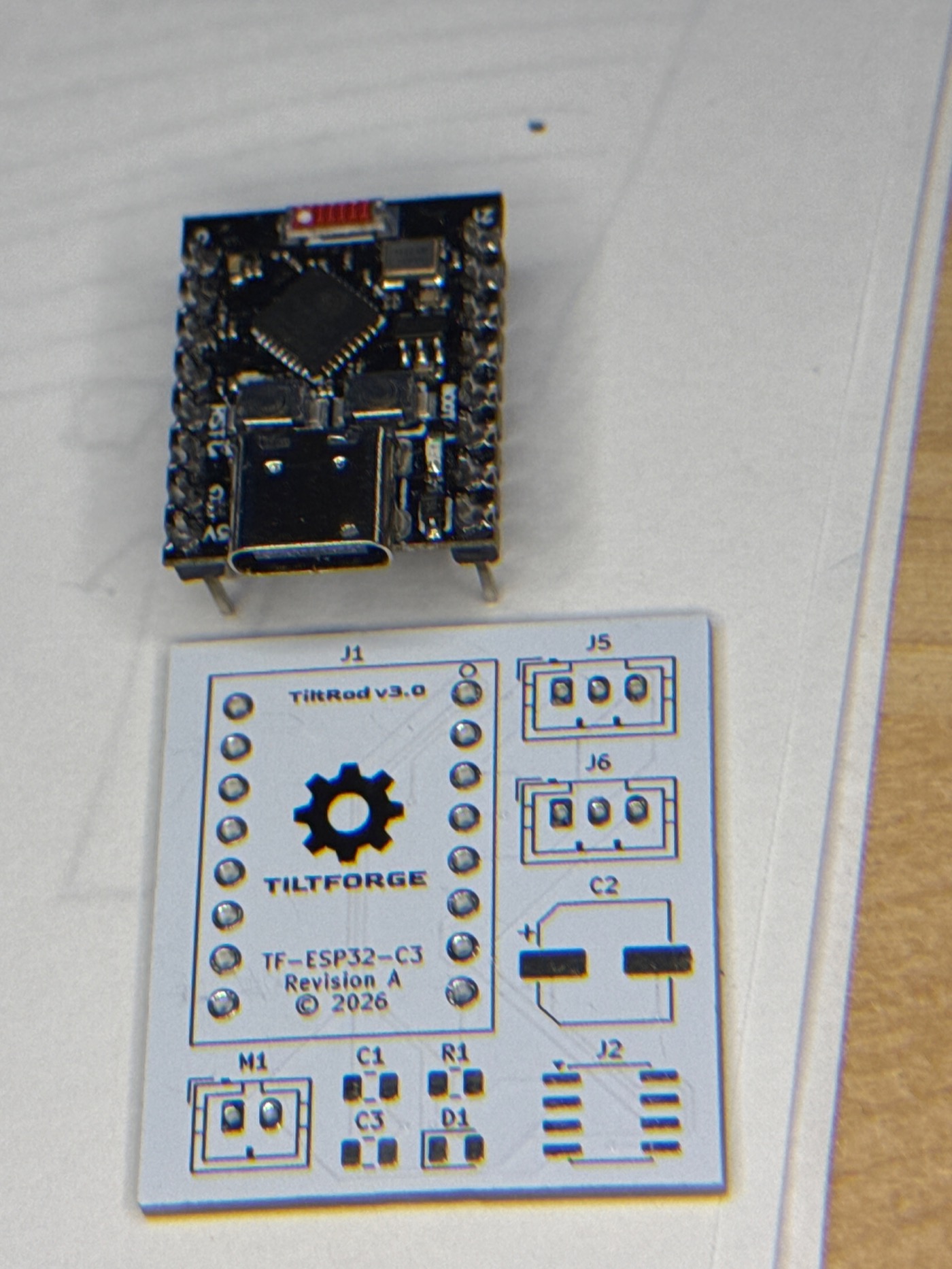
The first custom board, populated. The electronics kept maturing while the mechanicals kept auditioning.
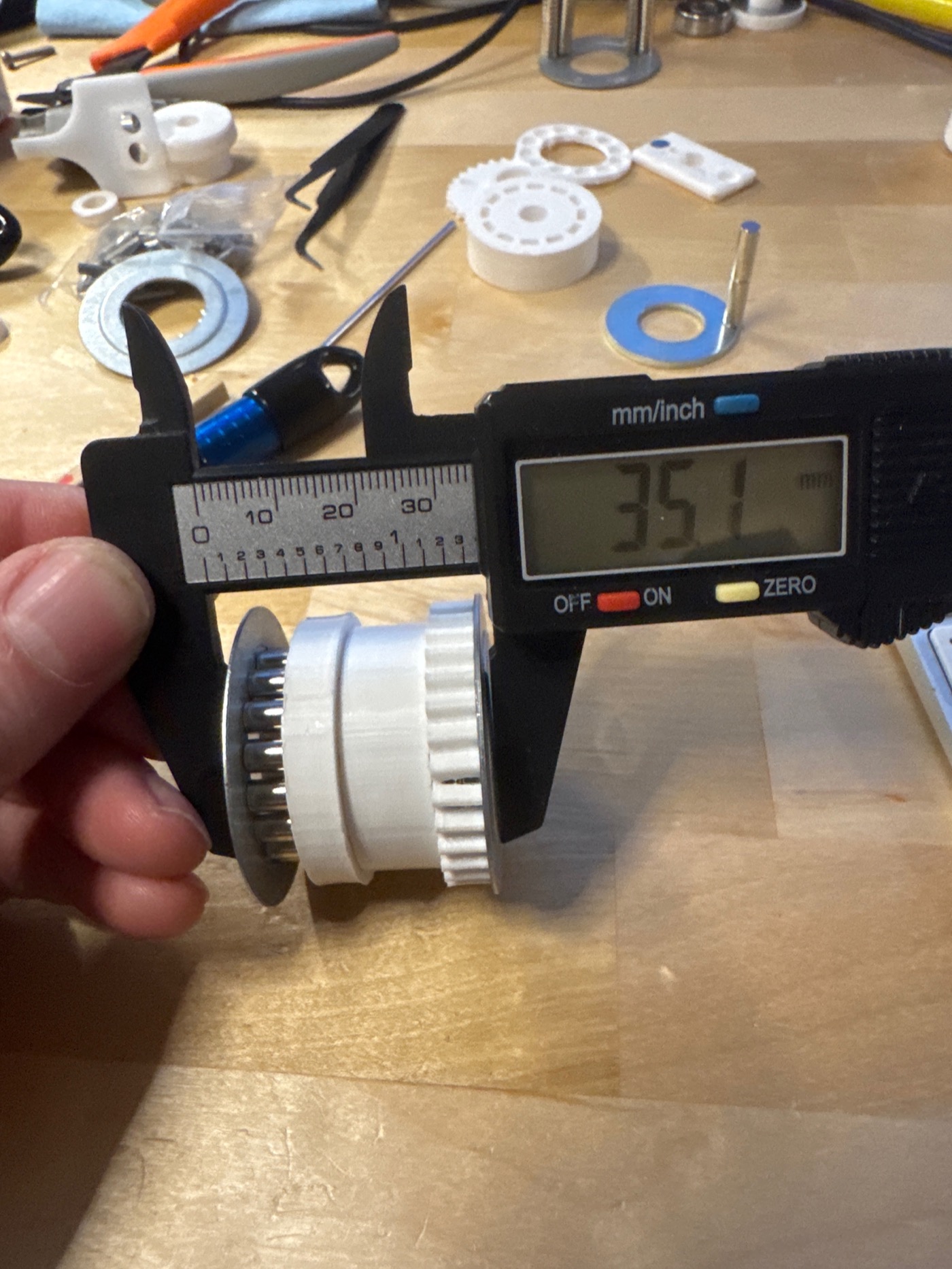
Still measuring.
The TiltRod, by TiltForge, is a retrofit smart blind motor — repairable, open, Matter-native, and the cord always works. Pre-orders are open now with founders pricing on the first 100 units; beta units ship September: tiltforge.com/products
TiltForge — a retrofit smart blind motor. Repairable, open, Matter-native, and the cord always works.
Follow the build — new entries straight to your inbox