Peak Complexity, Then the Delete Key
Post 5 of the TiltForge build journal — April 2026: the most sophisticated machine of the whole project, and the discipline to delete it two weeks later.
v9.0 — the 25-part machine
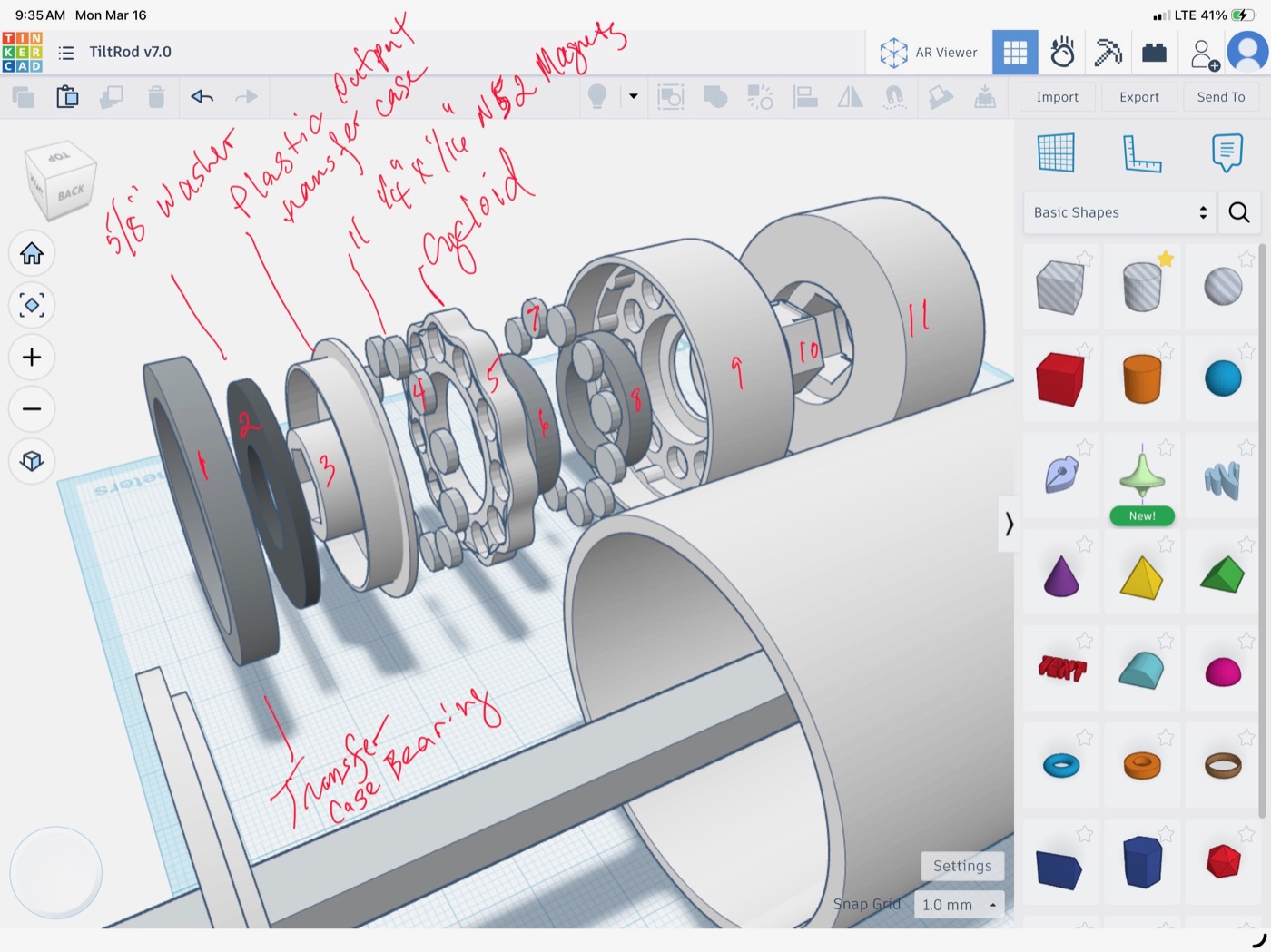
TiltRod v9.0: motor, spur, annular gear, eccentric cam, cycloid, oldham carrier — and parts 11 through 24 are a clutch stack. Peak complexity.
Here's the thing nobody tells you about peak complexity: it worked.
TiltRod v9.0 was twenty-five numbered parts — motor, spur, annular gear, eccentric cam shaft, cycloid disk, oldham carrier, and then parts 11 through 24: all-thread, flat washers, a wave spring washer, a fiber washer, a star washer, locknuts. Half the parts list was a clutch stack. I spent more bench time assembling that stack than anything else in the machine, which is funnier now than it was then — the washers were the part that would outlive everything around them.
When it was together and turning, I felt both things at once: proud of the most sophisticated machine I'd ever built, and uneasy about it for exactly the same reason. Twenty-five parts is twenty-five ways to fail. I kept looking at it thinking: I can build this. I cannot ask a customer to build this. And a kit you can't ship is a science project with delusions.
The education, timestamped
The watch history tells on me. April 15: a TinkerCAD worm-gear and thread-modeling binge. April 29: "The 90-Degree Torque Problem" and double-enveloping worm drives. Finished v9 sat on the bench while I studied — of all things — the humble worm drive I'd started with back in October.
I'd love to say I was doing due diligence. What actually happened is worse, and more useful: while I was fretting about the complexity, I had forgotten my own number-one requirement. The tilt rod on a blind lives downstream of the headrail's own worm gearing, and a worm drive cannot be back-driven. Drive the rod directly — which is what v9 did, sitting in-line on the rod — and the pull cord dies. No manual override, ever. The exact failure that started this whole project: eight windows of dead commercial motors that took the cord with them.
The complexity planted the doubt. Remembering that rule is what swung the axe. I had been treating "the cord always works" as a nice-to-have somewhere in my head, when it was the entire reason TiltForge deserved to exist. The machine on my bench worked beautifully and was disqualified by design.
April 21: two sentences to Shenzhen
There's a timestamped receipt for the delete key. On the morning of April 21, mid-thread with Kevin — my N20 supplier at Shenzhen Hotec, who had been patiently quoting sample motors for weeks while my spec kept moving — I sent this: "Changing from cycloidal to worm gear. Ratios will be way different. I will keep you posted." Two sentences, typed before eight in the morning, retiring months of work.
A week later, morning coffee and a YouTube search: "capstan drive
variations." Six capstan videos back to back; by that evening,
capstan.stl was in the day's folder. The rebuild was on. The capstan
wasn't a random rebound — it was the first architecture I'd found that
attacked the real problem: drive the spool side directly,
the same side the cord lives on, and let the blind's own worm gearing do
what it already does. Wrap a cord around the existing spool and a 90°
direction change costs you nothing. And the cord itself was a marvel —
braided line literally stronger than steel, flexible, quiet, effectively
wear-proof. (It had one weakness, and one hard problem I didn't respect
yet. That story gets its own chapter.)
I want to be clear about the cycloid, because I loved it. It never really broke. It was hypnotic to watch and genuinely novel to build — the annular gear let me offset the motor and still take reduction, which I remain quietly proud of. But it was big, it crowded the tilt wand, it needed an extra gear because of the offset, fitting the friction clutch into it was a fight, and above all it lived on the wrong side of the worm. The best mechanism I ever built, disqualified by geometry the day I remembered what the product was for.
Simplification cascade
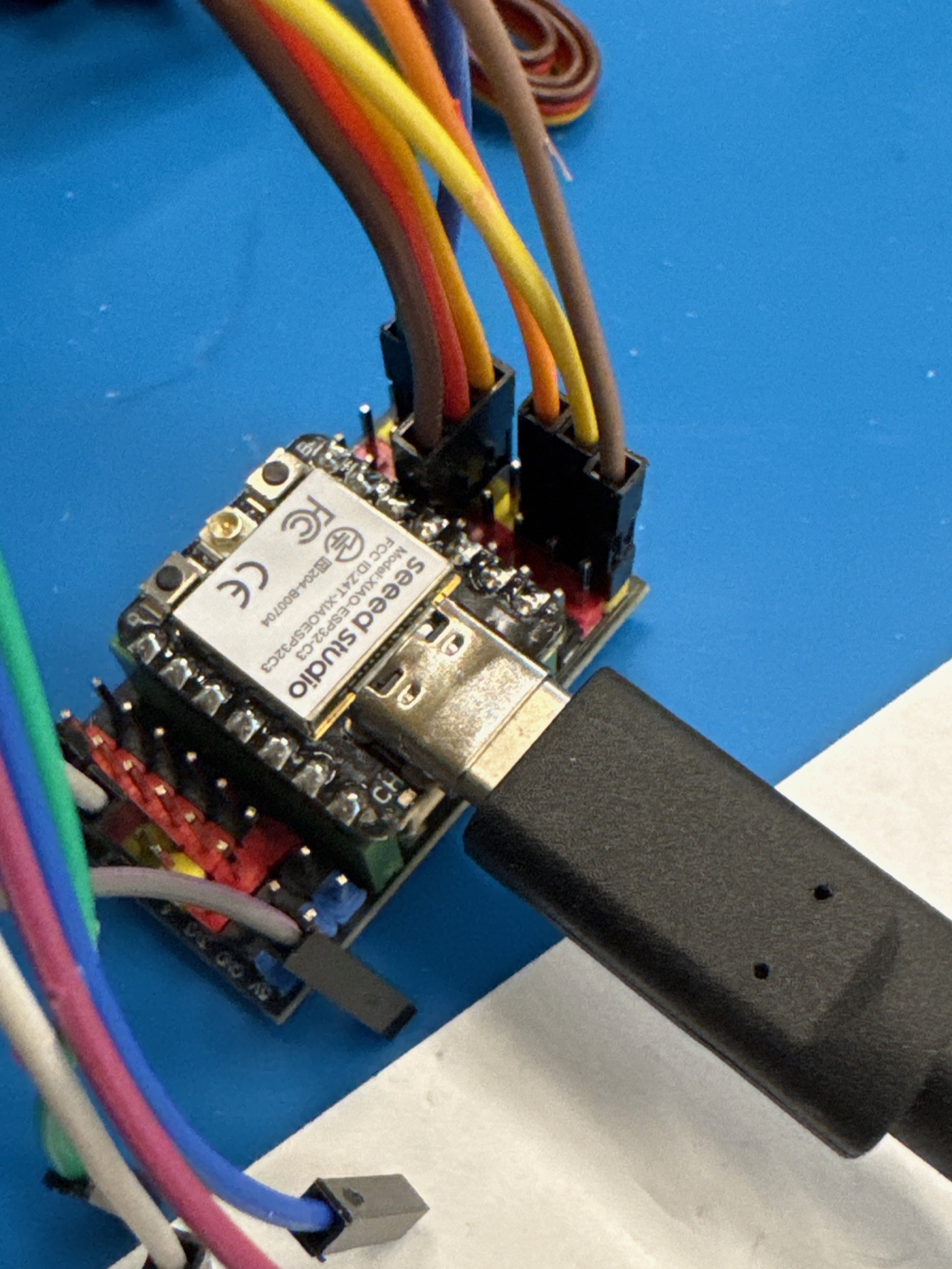
The war rig: Rev A's ESP32-C3 on jumper wires — the chip that could never fit the Matter stack. Its replacement gets the anticlimax below.
The same weeks the mechanicals were shedding parts, the electronics were fighting a war I hadn't budgeted for: Matter commissioning. Here's the fun fact the protocol brochures skip — commission a Matter device into HomeKit first, and Apple claims it: that commissioning is spoken for. Google, meanwhile, is too dumb to follow directions and even worse at relaying them. So the working order is Google first — and it works… maybe. Layer an integration on top and you're playing Russian roulette with three bullets in a six-chamber gun: something is going to drop. I bought an Android phone just to debug Google Home properly. I watched Google Home flake — integrations failing, features quietly dropped — and bought an Apple TV.
That stretch set product law for TiltForge: my wife and kids live with this thing. I want to install it, have it work, and never think about it again. Flaky is disqualifying, same as a dead pull cord.
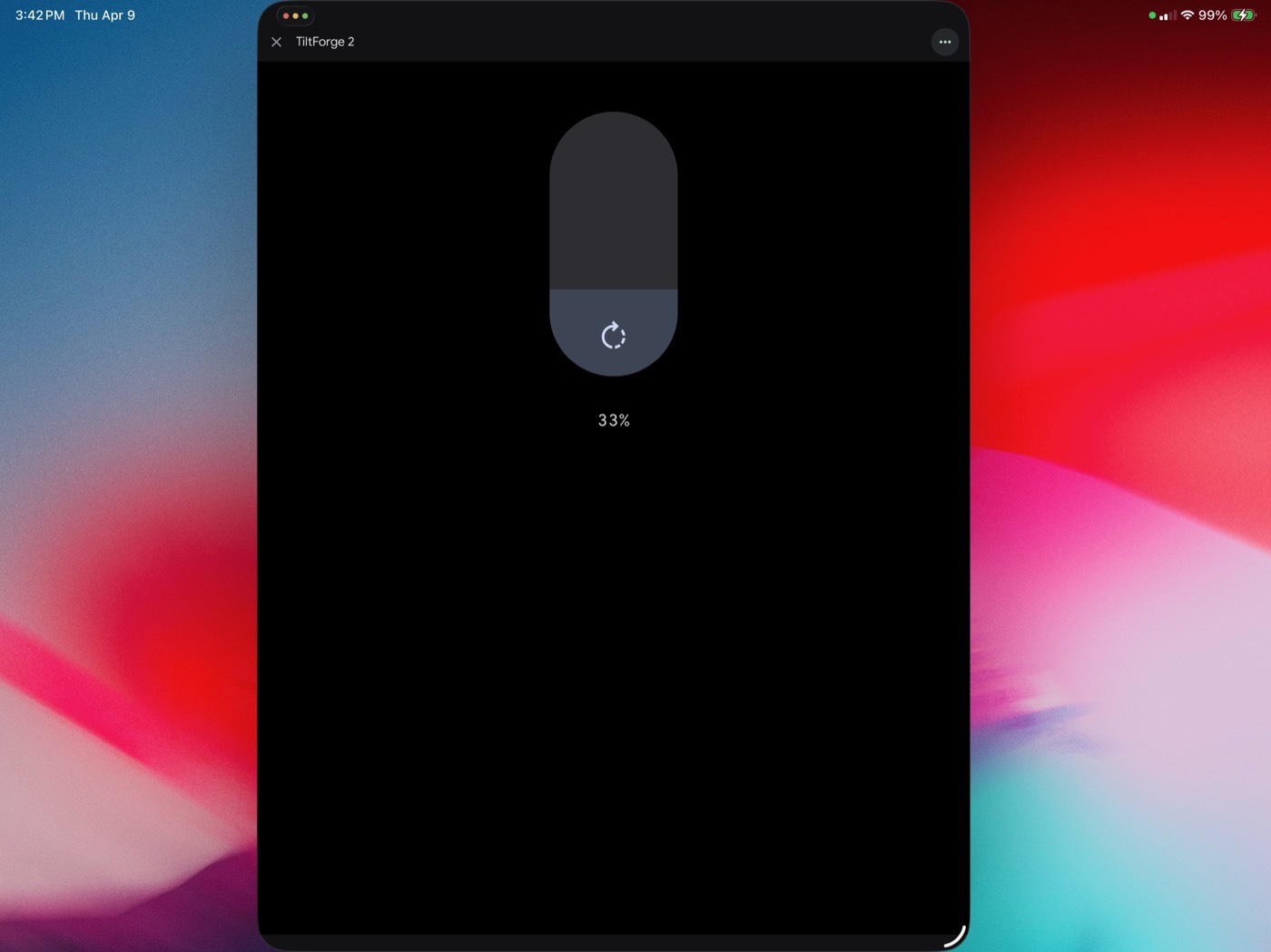
The payoff screenshot: a tilt slider, talking to my own board, holding at 33%.
The fix, in the end, wasn't a heroic 2 a.m. debugging scene. Rev A's ESP32-C3 simply never had the memory to run the Matter stack and talk to an ecosystem at the same time. The ESP32-C6 did. One unremarkable afternoon I flashed the C6 board, it paired, the tile came up, and the slider held at 33% like it had always worked. Months of fighting, and the win arrived as an anticlimax in broad daylight. I've decided that's what good engineering feels like: boring, on purpose.
What the shelf holds now
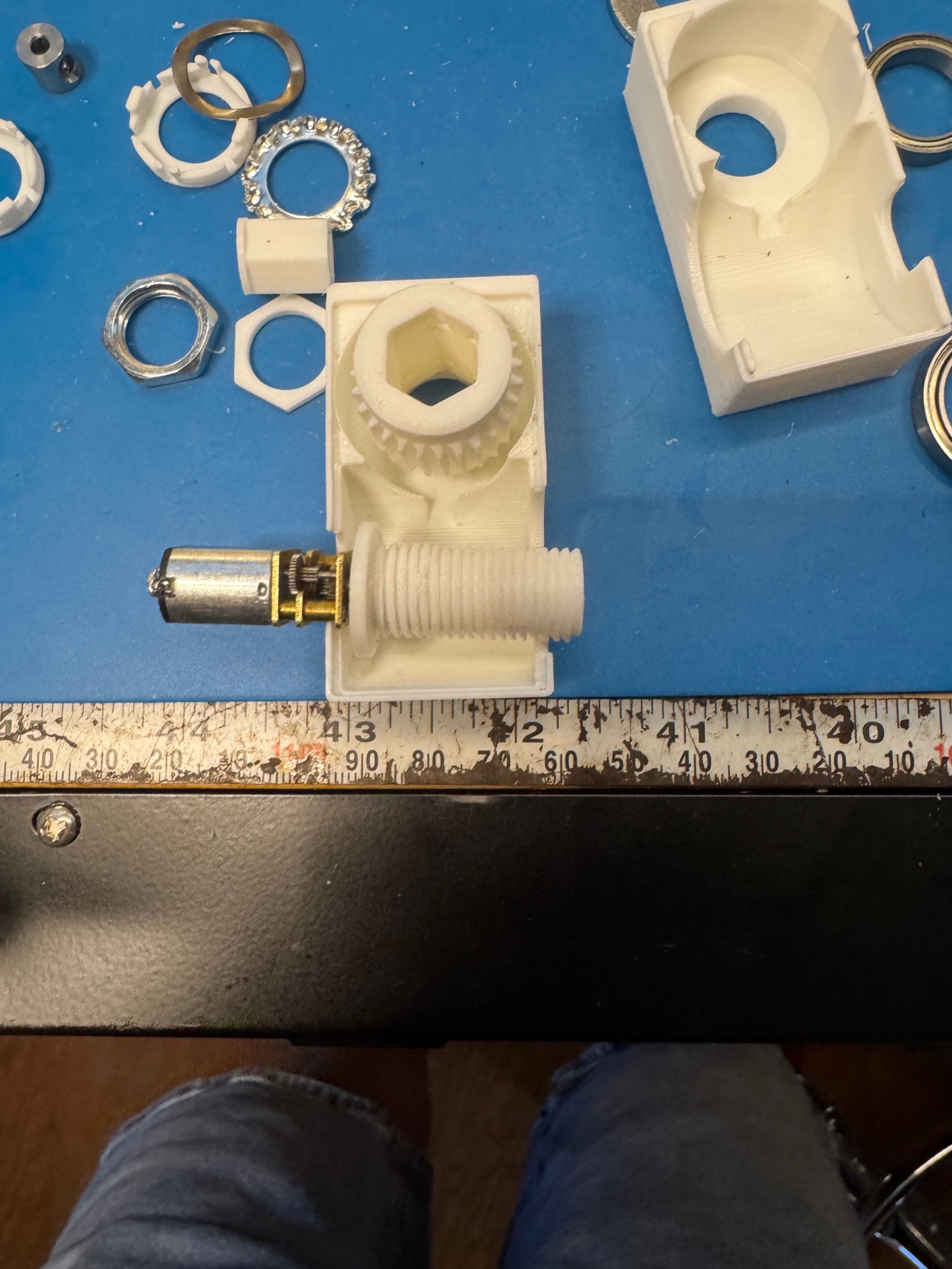
Where it landed: back toward the worm — the architecture from October — now with everything the detours taught me.
The v9 parts went to the boneyard that evening. In my shop that's a literal place: a sad little shelf where dead architectures sit like trophies. Failure trophies. I gathered them all once for a photo, but mostly they just sit up there — the planetary, the flexsplines, the magnetic rings, the cycloid.
I couldn't throw them away. Some of those designs I still love. They spun, they were clever, a few were genuinely novel. They just weren't what the final application needed — and the discipline this month taught me is that those are different things. The shelf is there to remind me I can delete my favorite work and the sky stays up.
Next post: where the company name actually came from (it's not who you think), the June the project grew up, and how the safety feature ate the transmission.
The TiltRod, by TiltForge, is a retrofit smart blind motor — repairable, open, Matter-native, and the cord always works. Pre-orders are open now with founders pricing on the first 100 units; beta units ship September: tiltforge.com/products
TiltForge — a retrofit smart blind motor. Repairable, open, Matter-native, and the cord always works.
Follow the build — new entries straight to your inbox