TiltForge
Post 6 of the TiltForge build journal — May and June 2026: the name, the rev-letter sprint, and how the safety feature ate the transmission.
The christening
This is the chapter where the naming ceremony should go, so I owe you the truth up front: there wasn't one.
The name came first, and it came from a robot. Back in December, frustrated that nobody had ever just solved this product so I had to, I asked ChatGPT for name ideas. TiltForge was the only one that ever came out of that box worth keeping, and I've used it since basically day one — it went onto the control-board designs almost immediately. I wish I could claim it. I can claim everything the name now stands for; the two syllables themselves go to the robot.
Get the two names straight, though, because they both survive: TiltRod
is the product — the machine this journal is about, the thing that
clamps to your headrail. It's been the TiltRod since October and still
is. TiltForge is the company above it, the shop the TiltRod comes
out of. For eight months the boards wore the company name while every
mechanical file led with TiltRod — and the first file to bridge the
two, TiltForge Blind 3.0 RevC.glb on May 24, wasn't a christening
either. That's the Rev C board model exported for this website,
inheriting the board line's naming convention. The parts design
aligned to the board convention; the paperwork followed the website.
No ceremony anywhere.
Full honesty while I'm at it: the naming discipline still isn't 100% nailed down. Parts and SKUs are still forming up, and the labeling heuristic gets formalized when inventory control actually demands one. Right now the machine matters more than the manifest.
What I can claim from December is the decision that shaped everything after: this would be built for everybody from the start, not scaled up from a one-off later. My usual pattern is build-for-my-house, then backtrack toward something shippable. This time every step was deliberate, and every shortcut refused. It cost speed — solve one window and you've exposed the two-window problem; realize the chip is wrong and the board changes; the board changes and the physical size changes — a trickle effect all the way down to the shell. So it went slower, and it went from the ground up — and the name on the files was always going to be the last thing to catch up.
Letters, not versions
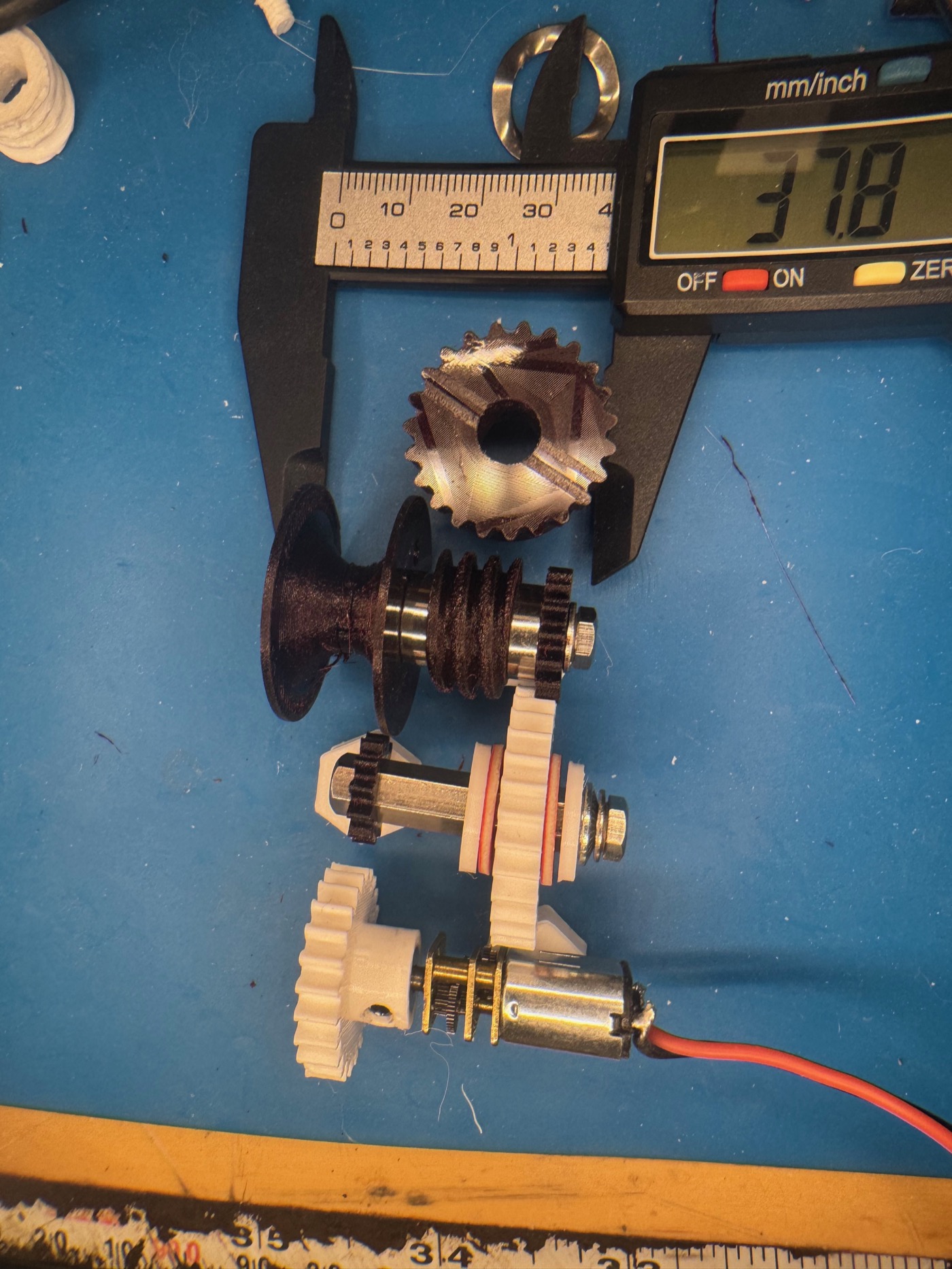
Rev letters under the calipers: h, i, j, k... n. This is the post-cycloid worm rev — still three shafts, with the clutch riding its own middle axle. The motor that collapses all this hadn't arrived yet.
June's folders read like a different engineer took over: rev letters instead of version numbers, exploded-view SVGs, and a formal as-built document — REV N8, gear tables with measured ODs and bores, the magnet hub deliberately moved away from the steel motor can so the AS5600 encoder reads clean.
Two things flipped that switch at the same time. The RevC control boards arrived — real manufactured hardware has a way of demanding real documentation. And the December built-for-scale plan finally surfaced in the file record: drawings made to communicate — to a supplier, to a kit builder, to future me — instead of drawings made only to print.
The clutch eats the transmission
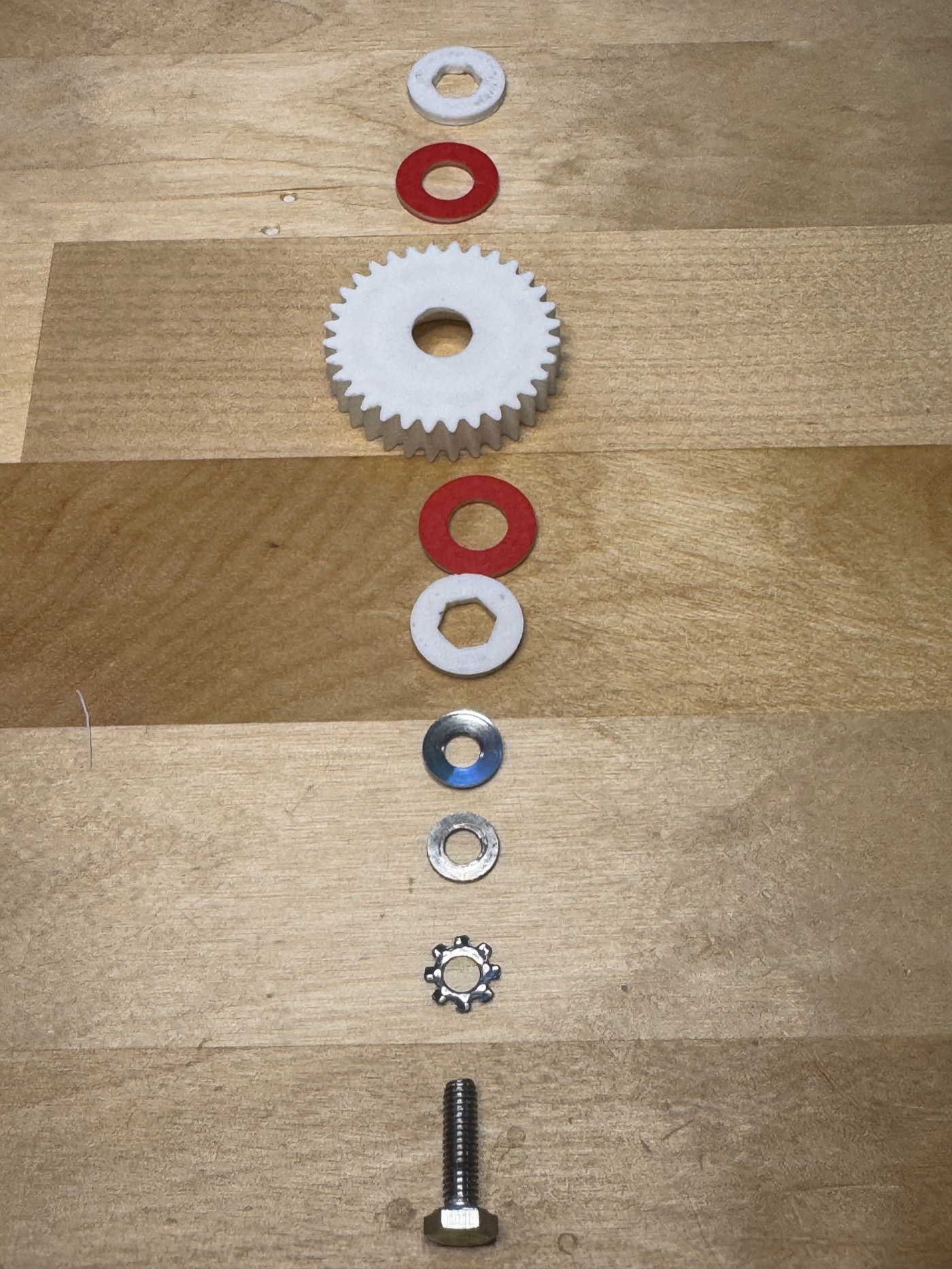
The clutch stack, knolled: friction washers, the drive gear, a Belleville washer, and the locknut that sets the preload. A "tunable cartridge — set preload, check feel."
The friction clutch entered this project in February as a footnote — overload protection, nothing more. By June it was the transmission. The recipe took iterations of its own — a coil spring auditioned for the preload job more than once, and lost to a Belleville washer under a locknut torqued to a set limit. Here's the case for a stack of washers over every proper gearbox I auditioned, and I'll stand behind all four arguments:
One part, four jobs. The stack is the drive coupling, the overload protection, the manual override, and the end-stop tolerance in a single mechanism. Grab the cord and pull: the clutch slips, nothing strips. Hit end-of-travel: it slips. Kid yanks the blinds: it slips. Every gearbox I built needed all four of those solved separately.
Slip never lies. Position comes from an AS5600 absolute magnetic encoder reading the drivetrain itself — not motor step counting. So slip loses nothing: the encoder always knows where the slats actually are, and a manual move shows up in the app like it happened in the app.
It can't stall the motor. The clutch slips below the motor's stall torque, which mechanically caps current draw. Overcurrent protection with no firmware in the loop — physics doesn't have bugs.
The wear part is a bag of washers. When a friction surface eventually wears, the replacement is a few dollars of fiber washers, not a gearbox, not a unit. The transmission is the repairability story.
And then there's the piece of this I didn't design so much as get handed. Through June, the worm revs carried three shafts: the motor, a middle axle whose whole job was holding the clutch, and the fixed axle with the worm and spool. Every revision cycle fought the same enemy — the N20's D-shaft, and how to hang a clutch off it. Then, in early July, Kevin — my motor contact at Shenzhen Hotec, who'd been fielding my spec changes since the cycloid era — sent a cut sheet for a motor that hit my spec almost exactly, with one line that changed the design: a threaded shaft option. I started asking questions and the answer was basically "we'll make you whatever you want." So: a custom N20 with an M4-threaded shaft and a lead that plugs straight into the board. The clutch stack threads directly onto the motor-side spur; the middle axle disappears from the design entirely; the transmission collapses to the motor plus one fixed axle carrying the driven gear, worm, and spool. Months of D-shaft contortions, deleted by one cut-sheet option box.
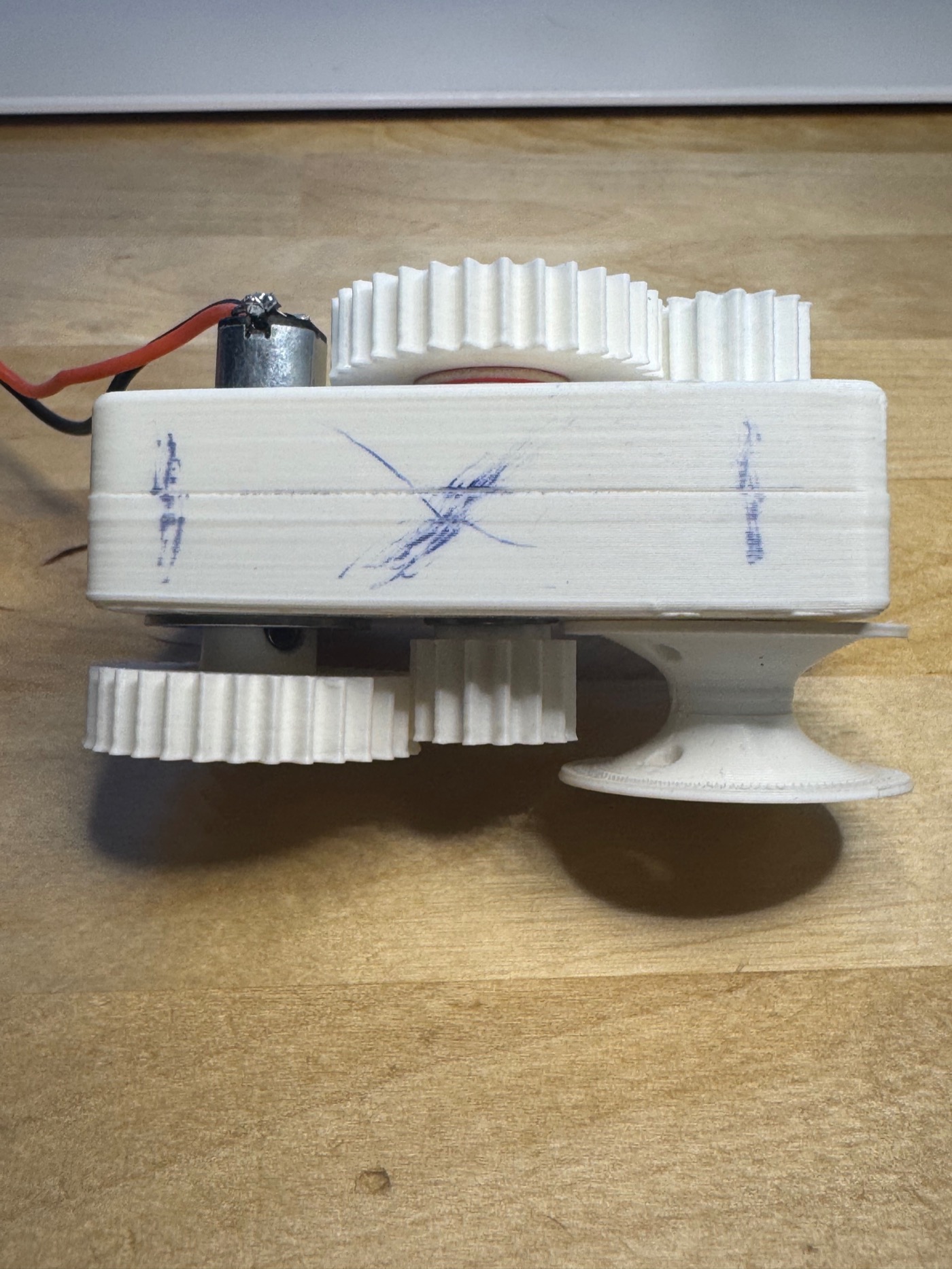
The runner-up, in full housing — all three shafts with their loadouts. The X came later.
And the cut sheet had a casualty: a machine I'd already finished. The gearbox above was cased, loaded, and ready to build — it's the design I was emailing Kevin about in the first place. I was close. I was done. Er — oh look, a squirrel. Yes, I did it one more time: deleted a finished machine for a better architecture. This time it was Kevin's fault. He fixed my design lock and never even knew it.
The assembly manual, by hand
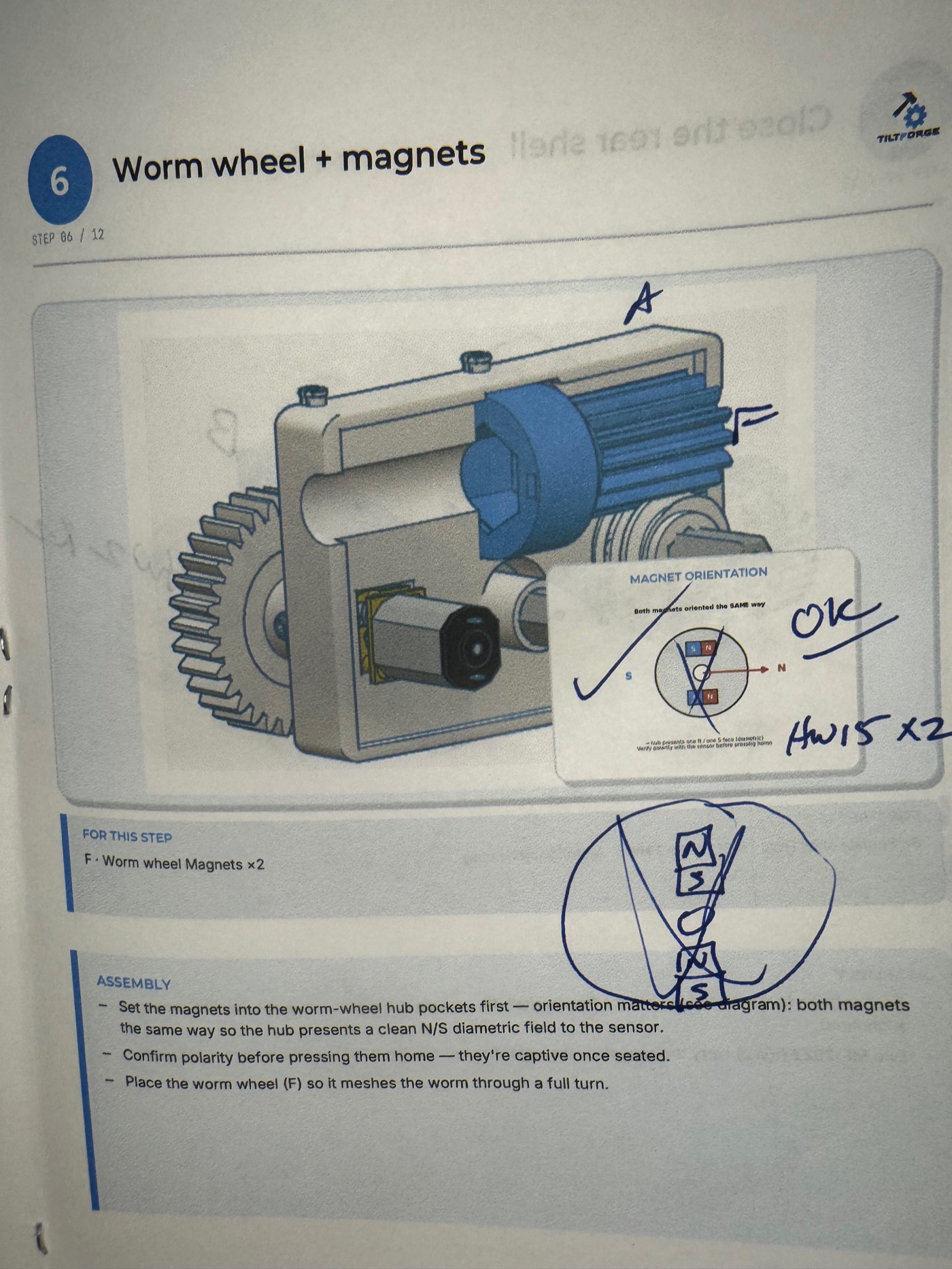
Writing the assembly manual by hand, with the parts on the pages.
Post 5 ended with the admission that I couldn't ship a 25-part machine. This is the other side of that discipline: a machine simple enough that I can write the assembly manual by hand — real pages, real annotations, the actual parts sitting on the paper while I write. Kits ship to people who deserve real instructions, and a product I can document by hand is a product I can support.
Eight months, one photo
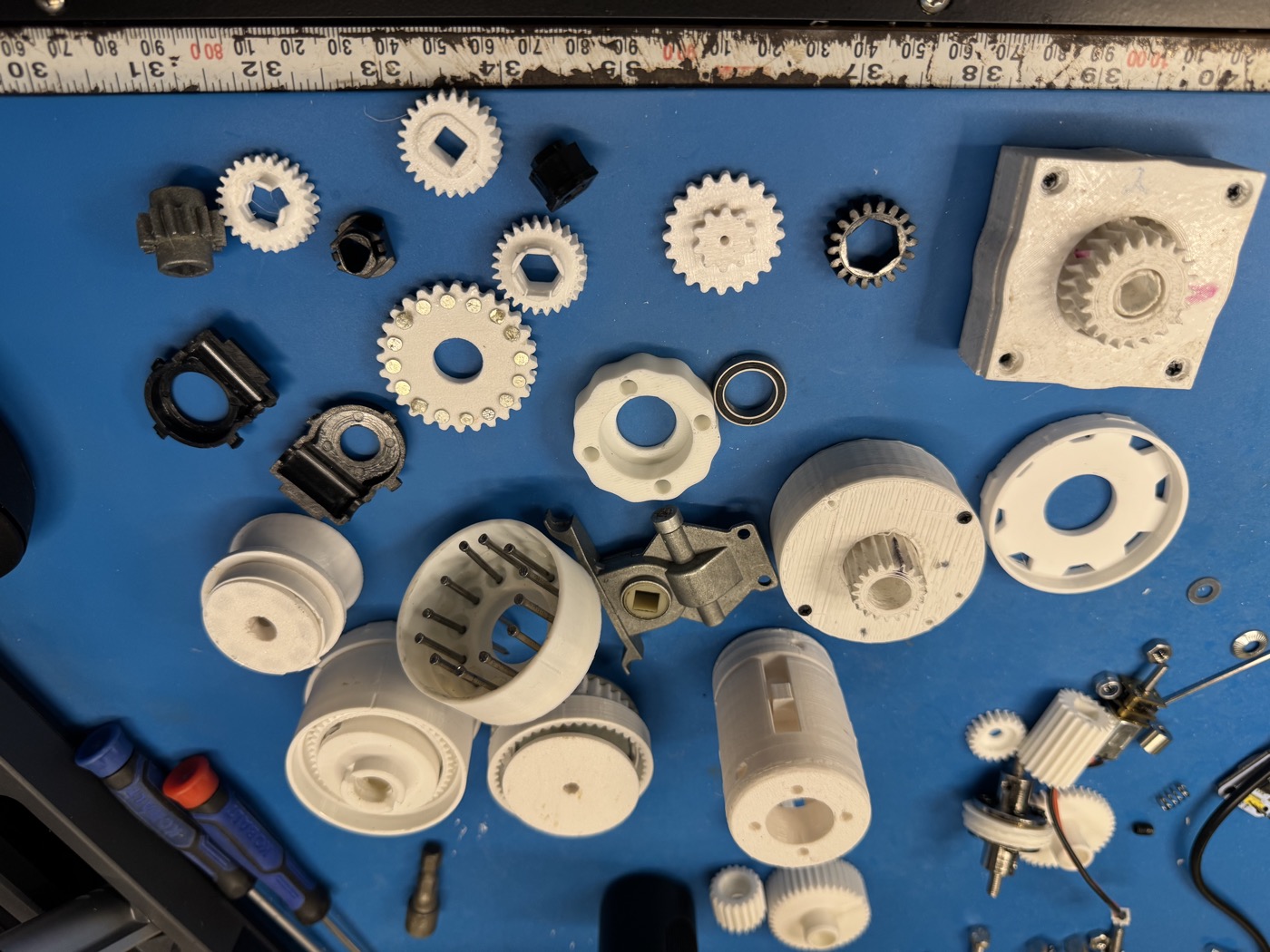
The boneyard, assembled for its portrait. Worm, planetary, harmonic, magnetic, belt, cycloid, capstan — every architecture, kept.
Roughly seventy dated build folders — a bench session every three and a half days for eight months. Every architecture got tried; every trophy went back on the failure shelf; and the winner was the part that snuck in as a safety feature. The sensors tell the same story in miniature: Hall sensors glued to a housing became magnets designed into gears became an absolute encoder engineered into the drivetrain. Everything consolidated toward fewer, better parts. The washers just got there first.
One more thing, while we're on names. I paid my way through college working for a shutter shop — custom interior shutters, built to order. I learned every part of that trade — sanding slats, planing stiles, assembling full panels, and finally spraying the oil-based enamel until the finish looked smooth as glass. Plantation shutters tilt their slats with — what else — a tilt rod. I think a TiltRod variant could learn to run them someday. Maybe it all comes full circle. We'll see.
This month, my wife finally watched a complete TiltRod drivetrain run on the bench — the machine all seventy folders were building toward. She has seen every failed iteration for eight months. Her full review, verbatim: "Yeah, this is great — but when are you going to actually fix the blinds?"
That's the rematch. It's coming.
The TiltRod, by TiltForge, is a retrofit smart blind motor — repairable, open, Matter-native, and the cord always works. Pre-orders are open now with founders pricing on the first 100 units; beta units ship September: tiltforge.com/products
TiltForge — a retrofit smart blind motor. Repairable, open, Matter-native, and the cord always works.
Follow the build — new entries straight to your inbox