The Drivetrain Runs
The motors landed
The new motors arrived this week. Every motor before these was bought on a hunch — the build journal opens with $190 of Amazon optimism and a BOM whose notes read like a graveyard ("great… a little noisy though," "quiet, but orientation wrong"). These are the opposite of a hunch: custom N20s from Shenzhen Hotec — model HT-SOG12C, 60 RPM at 6 V, built to spec by Kevin after a spring and summer of patient emails — a 4 mm M4-threaded shaft where every off-the-shelf motor forced a D-shaft compromise, and a lead that plugs straight into the board. The threaded shaft is the whole ballgame: the clutch stack threads directly onto the motor-side spur, the middle axle that used to carry the clutch disappears from the design, and the transmission collapses to the motor plus one fixed axle — driven gear, worm, spool. The design stopped bending around the motor; the motor got built for the design.
The washer stack meets its motor
If you've read the journal, you know the punchline of the whole series: after a worm drive, planetary gears, four and a half harmonic drives, magnetic gearing, TPU belts, three cycloidal campaigns, and a capstan, the transmission that won is a friction clutch — a stack of washers preloaded by a locknut, riding directly on the motor spur.
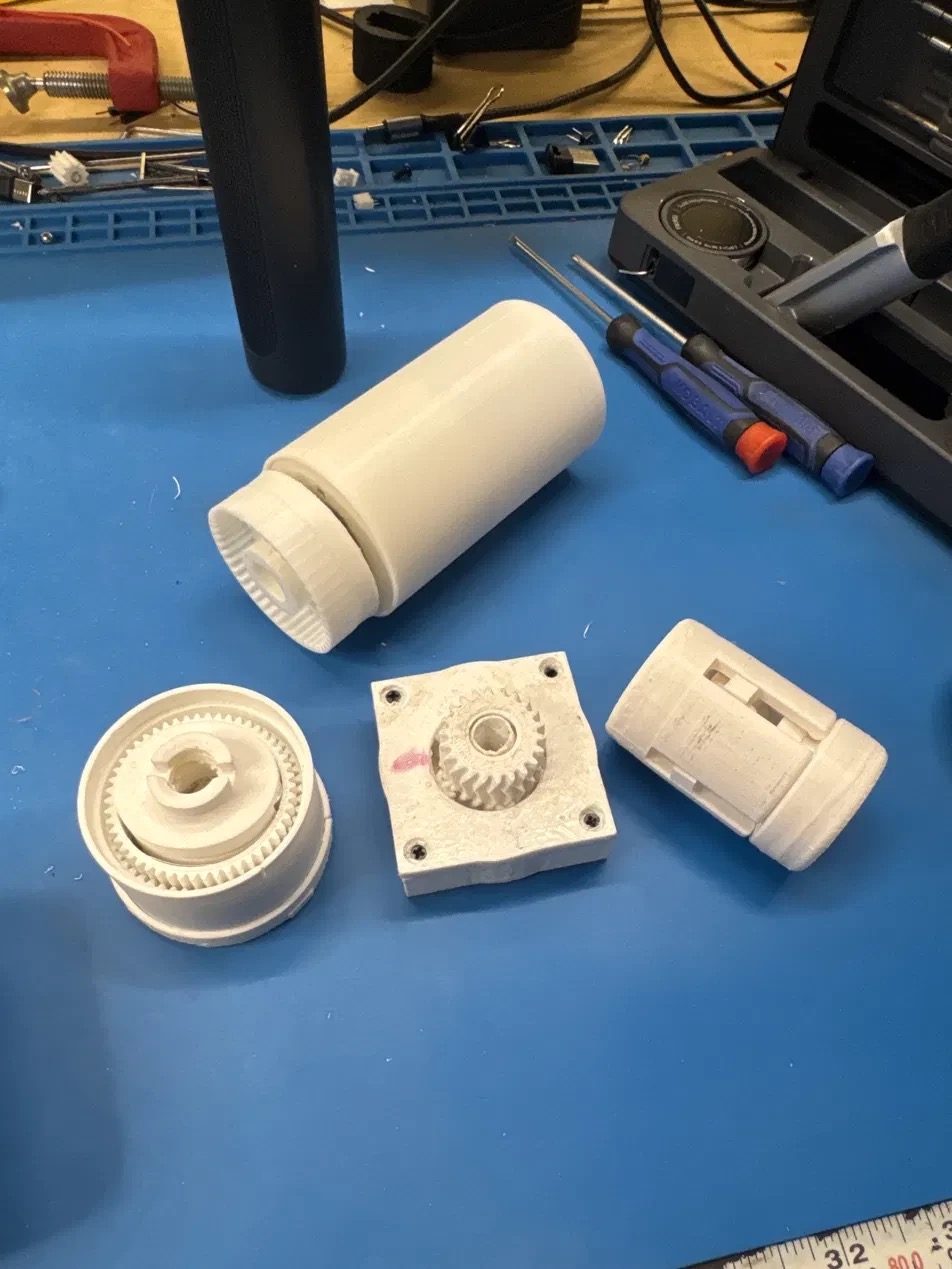
Four of the architectures that lost, still on the bench. Every one of them worked. None of them was what the application needed.
This week the clutch stopped being a design decision and became a running machine. Motor, clutch-on-spur, worm, spool, tilt rod: the complete drivetrain, assembled with the parts that will actually ship, doing its actual job. And quietly, a second first: the Rev D control board ran this test — the production electronics driving the production drivetrain, both for the first time, together.
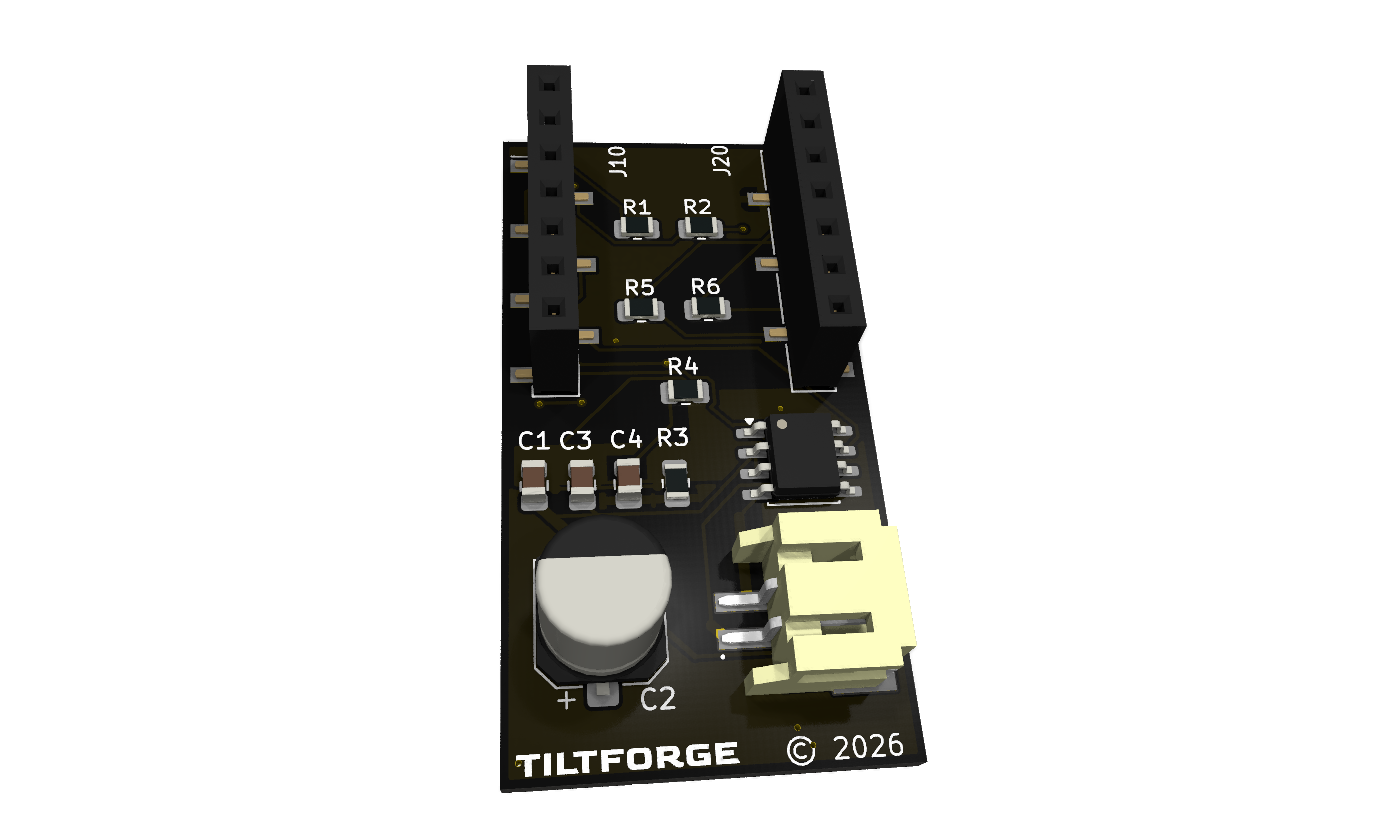
Rev D. The board that ran the bench test.
First complete run of the production drivetrain. Stay for the last angle — watch the spool spin, then lag: that lag is the friction clutch engaging when the spool binds.
Watch the last angle
The final shot in that video is the one I care about. You can see the clutch actually engaging — the part that entered this project in February as a footnote (overload protection, nothing more) physically transmitting the drive it eventually took over entirely.
You can also see a minor alignment issue: the gear mesh spacing is a hair off on these alpha shells — the spur-to-gear center distance isn't final, and you can see it in how the spool runs. The fix is already queued for the beta revision. I'm leaving it in the video on purpose — this journal has documented eight months of things not working, and it's not going to start airbrushing now that things do.
Two firmware tweaks and a button
The only casualties of assembly week were in firmware, and they were honest ones: the C6 on the bench was carrying the wrong firmware version for the manual button functions, and the direction mapping was flipped — up was down. For this test I just needed it spinning to prove the new motor and clutch stack, so: remap, reflash, run. That's the good kind of punch list — the kind you fix in an editor instead of a slicer.
Next: the head rail
What's on the bench is a drivetrain. What's in my family room is the reason it exists: windows whose commercial smart-tilt motors died years ago and took the blinds down with them. Next step is installing this drivetrain in the head rail and making those blinds function again — the same blinds that started this whole thing when they stopped.
The bench test was for me. The head rail is for the house.
The TiltRod, by TiltForge, is a retrofit smart blind motor — repairable, open, Matter-native, and the cord always works. Pre-orders are open now with founders pricing on the first 100 units; beta units ship September: tiltforge.com/products
TiltForge — a retrofit smart blind motor. Repairable, open, Matter-native, and the cord always works.
Follow the build — new entries straight to your inbox