The Sweet'N Low Packet

The photo up top is a Sweet'N Low packet with its corners torn off. It is also a cross-section of the TiltRod's shell, and the end of the last open mechanical problem on this project. Making it took four seconds and zero calories. Getting to it took a month. We'll get there.
The problem: the wand
Blinds give you one of two handles for tilt. Some have a cord. The rest have a wand — that clear plastic rod hanging off a hook at the corner of the headrail. You twist it, and blinds tilt.
Cord blinds, the TiltRod already handles: a spool snaps onto the end of the drive axle, your cord runs over it, and a pull tilts the blinds through the same worm the motor uses. That's the founding promise of this whole machine — the manual control always works, motorized or dead.
Wands are meaner, for a reason that's pure geometry. The TiltRod's drive axle exits the case pointing horizontally out at the room. A wand hangs from its hook pointing at the floor, because gravity is not negotiable. So the job is: twist a vertical stick, and make a horizontal axle turn.
The dangle problem
Every obvious answer involves hanging something between the two — and I proposed most of them, some in the same week, each one feeling stupid-simple-effective for about an hour. A clevis pin through the axle with a ring shackle on it. A twist shackle. Two links of jack chain, one on the axle, one dangling for the wand's hook.
They all die on the same piece of physics. Anything that hangs loose — links, hooks, chains, shackles — is a tension device: it transmits pull beautifully and torque not at all. Twist one end of a slack chain and the far end doesn't turn; the twist just winds into the hang. So the wand spins, the hardware stirs in a lazy circle, and the axle sits there watching.
A dangling connection cannot carry twist around a corner. Not with better links. Not with more of them. Physics wasn't voting on this one.
The rabbit hole with a plaque at the bottom
In the middle of all this I designed the nicest part I've drawn on this project: a two-piece snap knuckle. Each piece carries a pair of balls. Snap two pieces together at ninety degrees and each pair grips the other, making a joint that bends almost thirty degrees in any direction, has zero rotational slack while it hangs under tension, and pops apart on an overload yank instead of breaking — then presses back together by hand. Two identical printed parts. No fasteners, no pins, no springs.
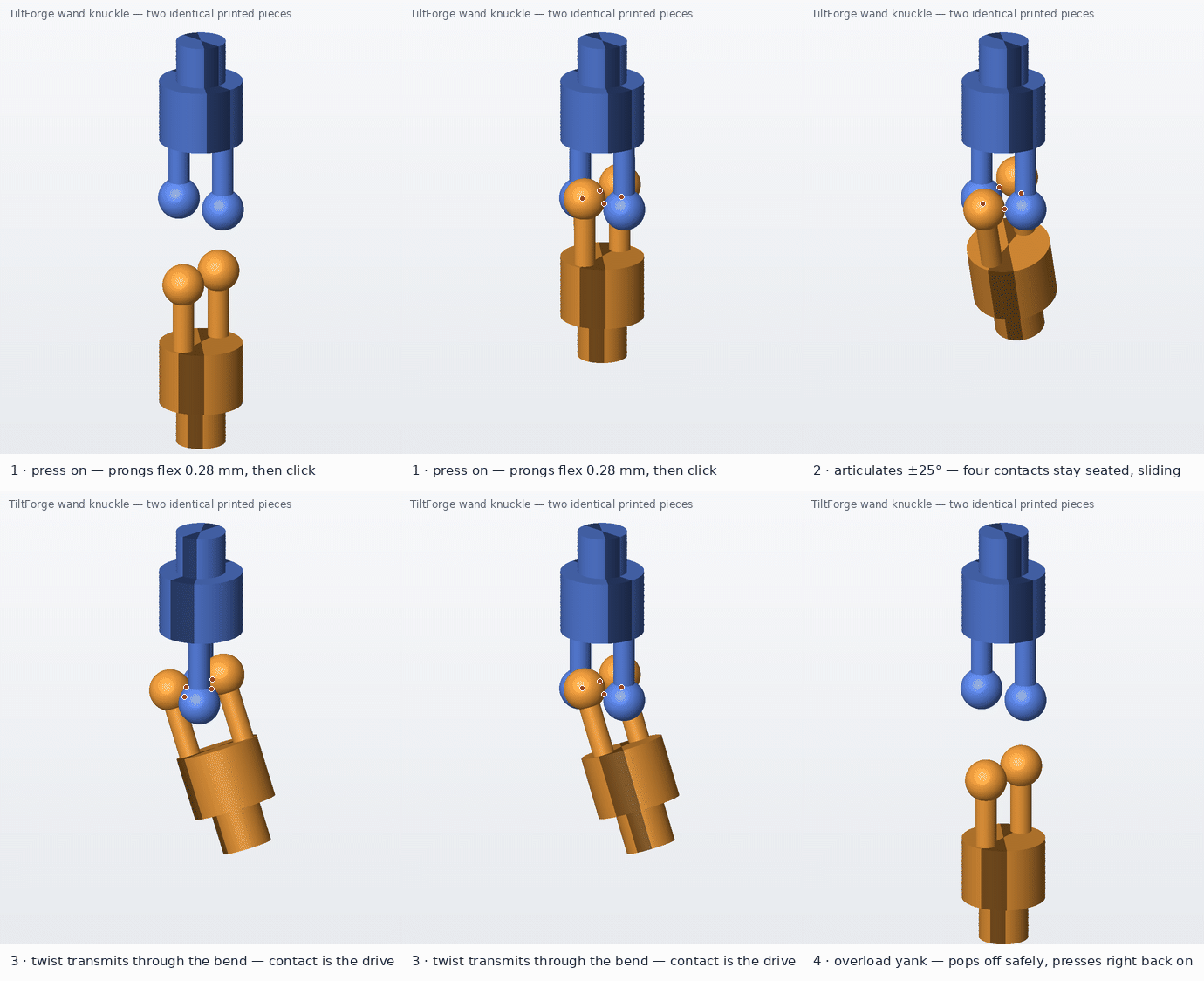
The math checked out. The clearance sweeps checked out. The prints are on the bench now. So naturally, while writing up how it worked, I went looking for prior art — and found Carl Weiss, who patented the kinematic heart of this joint in 1923. The Bendix-Weiss joint steered WWII Jeeps. This is the first part of this project born in parametric code-CAD instead of TinkerCAD, and it arrived a hundred and three years late to its own patent. The journal's brand of humility remains undefeated.
The knuckle earns its keep anyway — hold that thought. But it doesn't solve the wand problem on its own, because past its bend limit a knuckle is just a fancier chain link. The axes still have to almost line up. And a vertical wand and a horizontal axle are as far from lining up as this problem allows.
Copy the working model
Back in the spring, the worm drive got picked by tearing down the blind's own native tilter and copying what a century of industry already knew. Same move here: how do the wand-tilter people do it?
Sneaky answer: they don't turn the twist around the corner. They tilt the corner out of existence. Look closely at a native wand tilter and the input shaft is inclined — the drive axis leans so the hanging wand and the shaft point nearly the same direction. Nobody transmits torque through the dangle, because nobody sane asks a hook to do a shaft's job. They just arrange for the hanging part to carry no twist at all.
Rotate the machine
Which is when it finally clicked — not a new part, a new question. The TiltRod clamps around the tilt rod, and the worm couldn't care less what clock angle the body takes around that rod: the mesh is round. The body's orientation is a free variable, and for eight months I'd left it parked at "level."
So: rotate the machine. Install the unit clocked thirty-some degrees around the tilt rod — a pendulum leaning against a foot — and the drive axle that used to point horizontally now points down and out, well inside the knuckle's reach of plumb. The wand hangs straight down like it always has, the knuckle bends the last few degrees, and the twist runs down a line of parts that are all pointing more or less the same way. Exactly like the native tilter, except the incline comes from how you hang the machine, not from a redesigned gearbox.
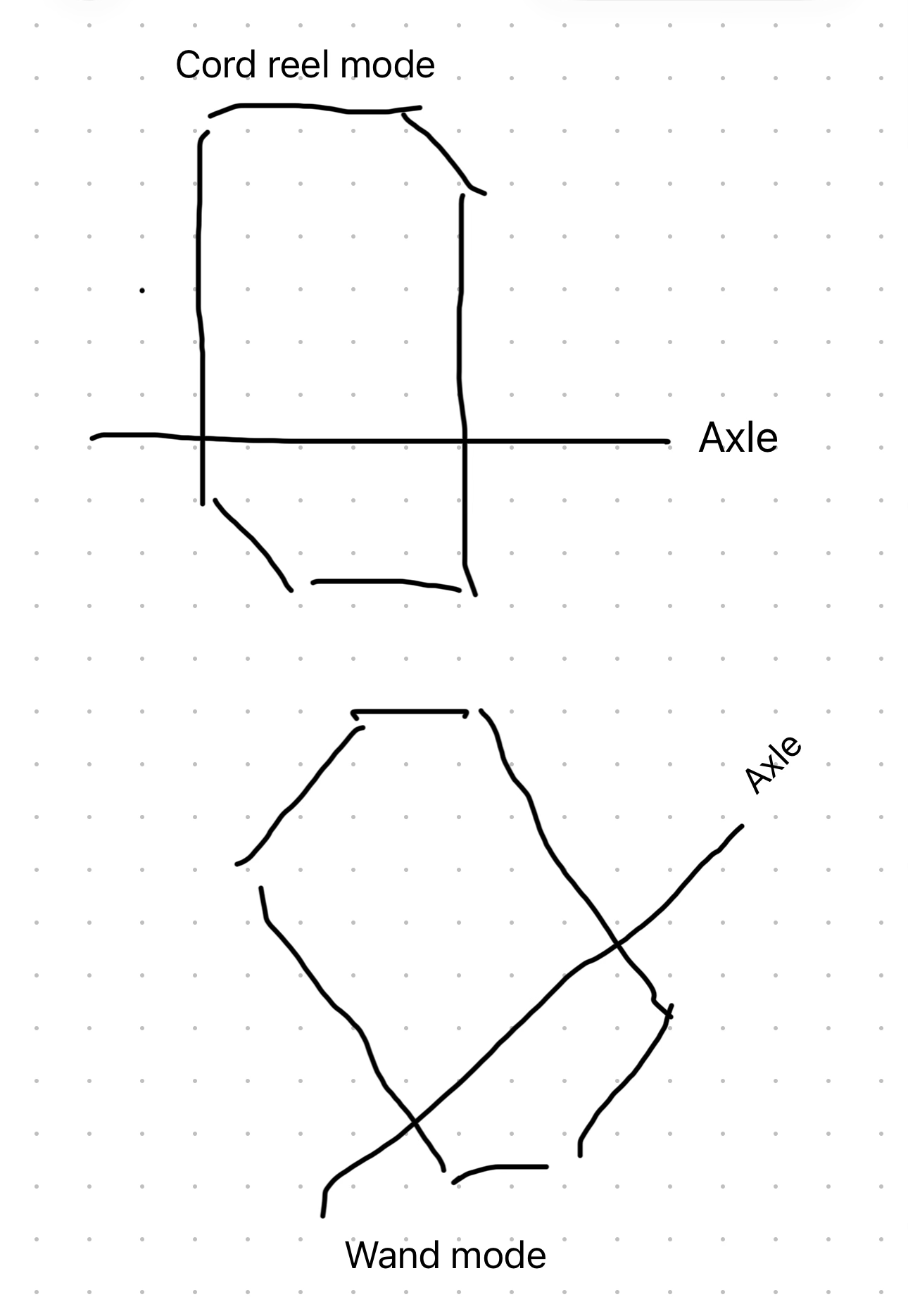
Wand mode stopped being a mechanism. It's an install orientation.
The packet
One question left: what holds the body at that angle? A worm kicks back against its housing, and the kick alternates with drive direction, so the seat has to register the angle and brace both ways. I was turning that over at the coffee counter — thinking about the shell's cross-section, waiting on the coffee — next to a bowl of sweetener packets.
Tear one corner off the packet: that's the shell with a chamfer cut into its bottom edge — a flat facet that sits square on the headrail when the body leans to its wand-mode angle. Tear the opposite corner: same shell, leaning the other way, for windows where the wand hangs on the other side. Hold it up. Done. The whole wand-mode shell revision, modeled in torn paper before the coffee finished.
Wand mode: solved with a Sweet'N Low packet while making a cup of coffee. Engineering at its finest — and I only half mean that as a joke. A cross-section you can tear, tilt, and hold against the light answers "will this seat?" faster than CAD does.
The delete key strikes again
If you've read part five, you know this journal's recurring lesson: every time this machine got better, it got better by losing parts. The wand drive spent weeks in my head as a crown gear and pinion — a second gearbox riding the first, just for wands.
What walked away from the coffee counter instead: zero new mechanisms. A chamfer on a shell that already exists. One printed hanger eye that snaps onto the same axle end where the spool snaps for cord mode — same four-ball knuckle interface, so cord mode and wand mode are the same machine with one attachment swapped. Your existing wand hooks into the eye the same way it hooked into the tilter it replaces. And the knuckle that turned out to be a 1923 CV joint earns its keep as the one coupling both modes share: self-aligning, zero slack under hang, and it pops off under a hard yank instead of breaking — Weiss supplied the kinematics; we added the snap.
What's next
Fit tests: the knuckle pair, the spool socket, and the hanger eye are printing now, and the snap forces get measured against the math that promised them. The chamfer's exact angles get computed into the beta shell revision, which was already queued for the gear-mesh fix. And the head rail is still waiting — the blinds that started this whole project haven't moved yet. That post has had its title reserved for months.
The bench was for the drivetrain. The coffee counter, it turns out, was for the wand.
The TiltRod, by TiltForge, is a retrofit smart blind motor — repairable, open, Matter-native, and the cord always works. Pre-orders are open now with founders pricing on the first 100 units; beta units ship September: tiltforge.com/products
TiltForge — a retrofit smart blind motor. Repairable, open, Matter-native, and the cord always works.
Follow the build — new entries straight to your inbox