Where the Magnet Goes
A dispatch from the bench, September 2026. The production motors are weeks out and none of this waits on them: the crown gear fit is where the last three weeks went. Measured off the meshes and the Rev D fab files.
The constraint
The AS5600 resolves angle from the direction of a field it assumes is uniform across four Hall elements on the die. It needs a diametrically magnetised disc centred over the package. There is no off-axis mode; an off-axis ring does not degrade gracefully, it goes non-monotonic.
The tilt rod passes straight through the shell, a Ø11 through-bore in both halves. So there is no shaft end to put a magnet on.
The crown gear solves that. A 12-tooth module-1 spur fused to the worm wheel drives a 16-tooth crown gear, which turns the rod's horizontal rotation onto a vertical axis, gives a free shaft end pointing at the board, and puts the magnet on-axis over the die. It is a sensor pickoff, not a drive element. It is also the most important printed part in the set, because its tooth quality is the angle noise floor.
The numbers
- 12T into 16T is a 0.75 step-down. Over a full 180° tilt the crown turns 0.375 of a revolution: 1,536 of the encoder's 4,096 counts.
- Resolution at the rod: 0.117° per count. A blind does not need that; backlash and clutch hysteresis will limit you long before the encoder.
- Headroom before the absolute reading wraps: 2.7×.
- Misalignment budget: AMS allows ±0.25 mm radial. The stack (print tolerance, a 0.271 mm printed journal, PCB stack-up, footprint) RSSes to 0.274 mm. About ±1.1° at the crown, ±1.5° at the rod. Invisible on a window blind. I would ship it, and I am.
The magnet that does not fit
The crown's snap post carries a Ø7.062 × 1.65 mm blind pocket. The AMS reference magnet for the AS5600, and what most vendors ship when you ask for an "AS5600 magnet," is Ø6 × 2.5 mm. It is 0.85 mm too thick. It would stand proud of the post and force the air gap open.
The part is Ø7 × 1.5 mm, diametric. Not axial. Axial discs of the same size are more common in the catalogues, and an axial magnet gives a reading that looks alive and means nothing.
The 1.80 mm
The sensor is on the bottom of the Rev D board. Everything above it is now measured, so the air gap reduces to one free variable: how far the sensor shelf stands off the PCB.
air gap = shelf standoff + 1.45 − 1.75 − magnet recess
With the magnet flush, that is standoff minus 0.30 mm. For the 1.0 to 2.5 mm gap the sensor wants, the shelf's bottom face sits 1.30 to 2.80 mm above the board, target 1.80. If the shelf sits on the board, the magnet hits the sensor package.
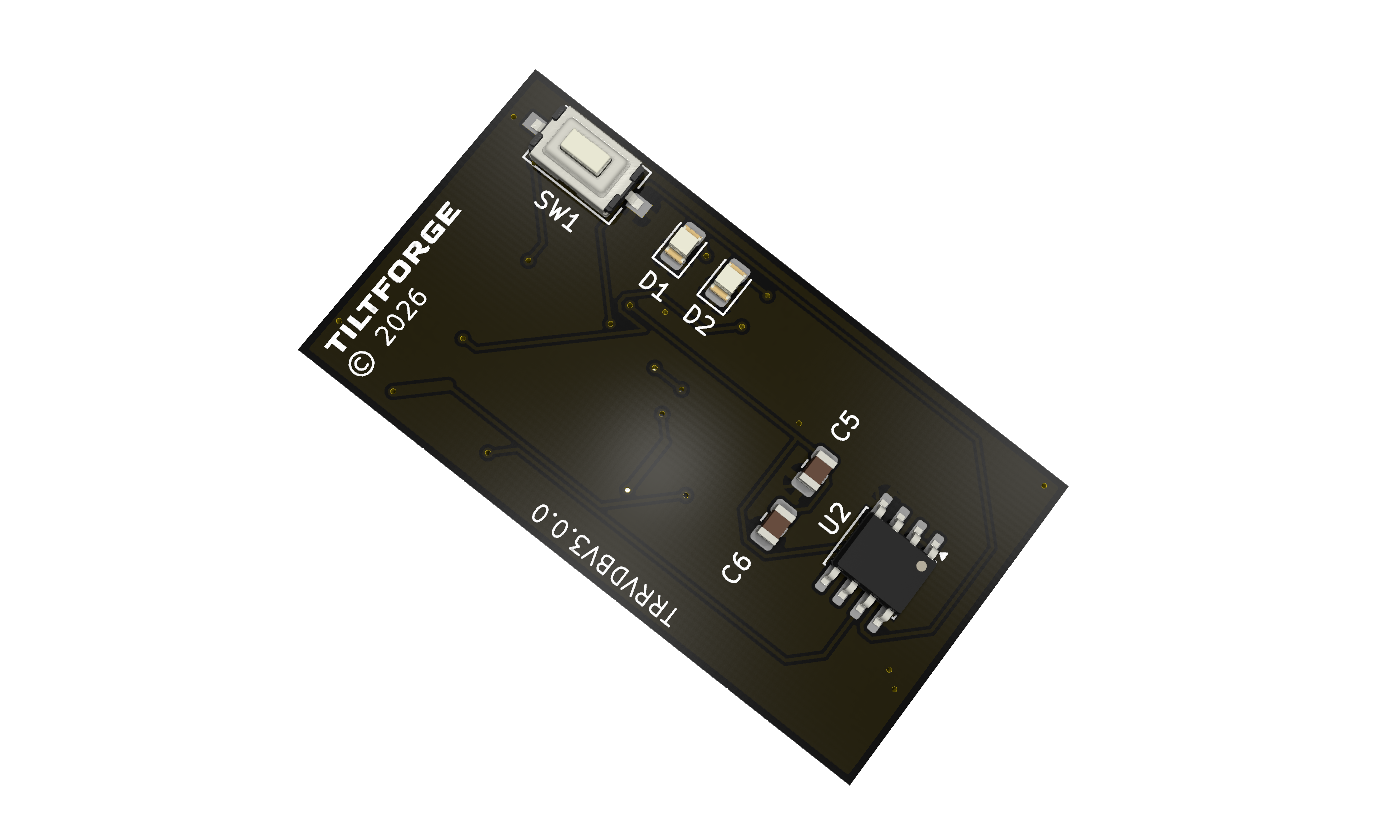
Rev D's bottom side, from the board render. U2 is the AS5600, C5 and C6 beside it. The magnet rides over that package on the crown gear's snap post, nominally 1.80 mm off the board.
And one trap: the AS5600 die is 0.295 mm off the board's geometric centreline. Register the shelf bore on the sensor's real position (10.455 mm from the long edge, 6.185 from the short edge), not on board centre. A board-centre assumption alone spends the whole ±0.25 mm budget.
Verify it on the bench, not on paper. The firmware prints the AGC on boot; mid-scale, about 64 on the 3V3 scale, means the gap is right, and it beats every calculation above.
Two more items from the audit
The crown gear STL carries 761 non-manifold edges. That is a TinkerCAD boolean on a high-segment revolve, and it means the one part that sets encoder accuracy could not be trusted to a tenth. It goes back through a real kernel before the next fit round. And the AS5600's one-shot burn commands are deliberately not implemented; the zero point lives in NVS, where it can be recalibrated in the field and survives a sensor swap.
The TiltRod, by TiltForge, is a retrofit smart blind motor — repairable, open, Matter-native, and the cord always works. Founders pricing on the first 100 units; first units ship November 2026. Check your headrail at tiltforge.com/fit or follow the build at tiltforge.com/#waitlist.
TiltForge — a retrofit smart blind motor. Repairable, open, Matter-native, and the cord always works.
Follow the build — new entries straight to your inbox